
Website and Facebook forms
Round robin among the three juniors. These are first-time buyers asking about family floater cover, and speed matters more than seniority.
NewRMDialer is now on iPhone as well as Android · every feature except the call log
Lead distribution system
A lead distribution system is a few written rules plus software that applies them the same way every time. Here are the methods, which ones RMDialer offers and which it does not, and how a team writes its own rules.
Free personal dialer. Paid features include a 3-day trial; no card required.
Team plans: ₹159/user/month, billed yearly + taxes →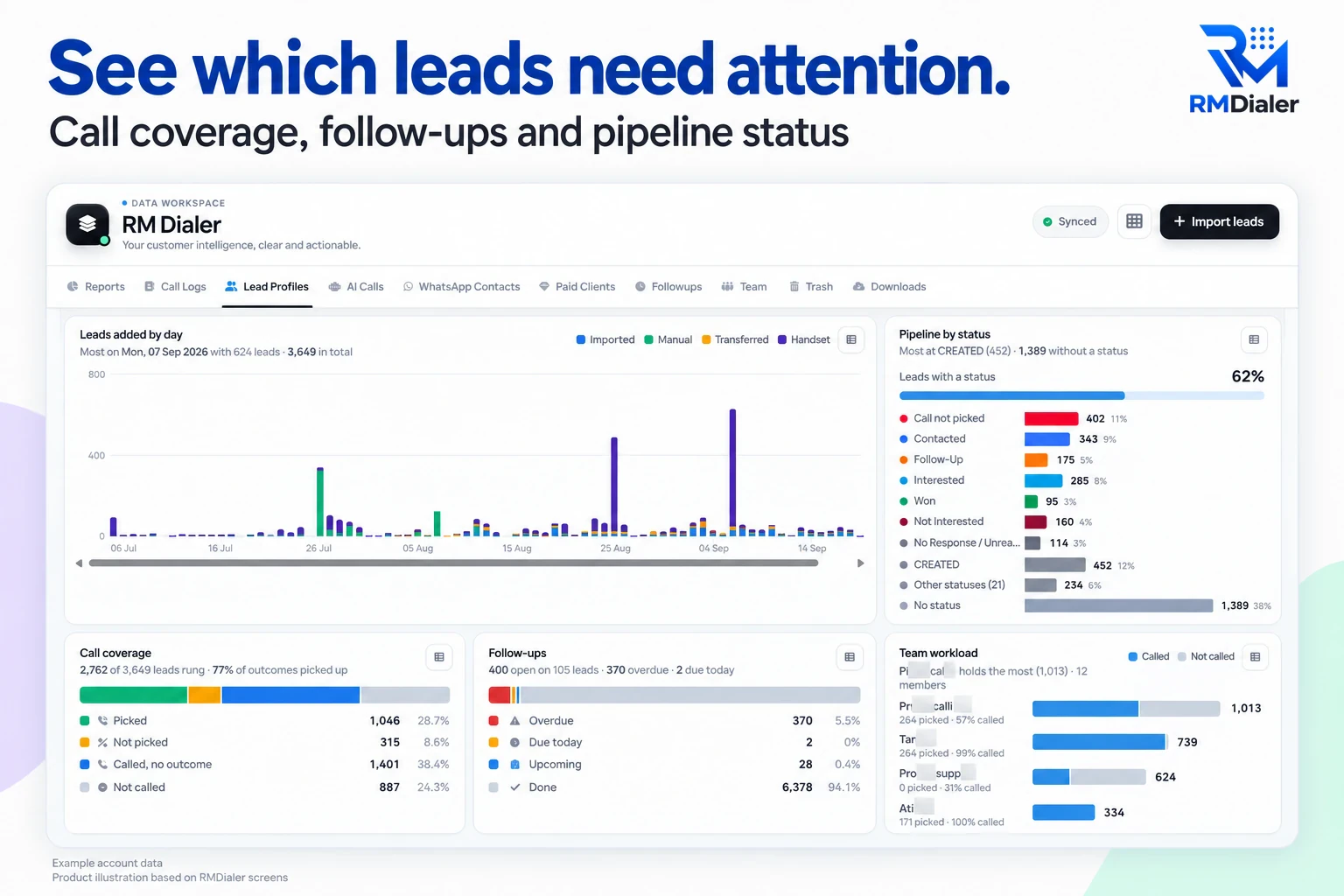
Coverage and workload show whether distribution turned into calls.
Short answer
A lead distribution system works by applying a fixed rule to every new lead: which source it came from, which group that source feeds and whether it rotates, stays with an existing owner or waits for a manager. RMDialer applies round robin, groups per source, manual assignment and transfer, and shows afterwards whether each lead was actually called.
Key takeaways
Seven methods, honestly marked
Most teams need two or three of these, chosen per source. The last column says plainly which ones RMDialer offers, so there are no surprises in a trial.
| Method | How it decides | Best for | In RMDialer |
|---|---|---|---|
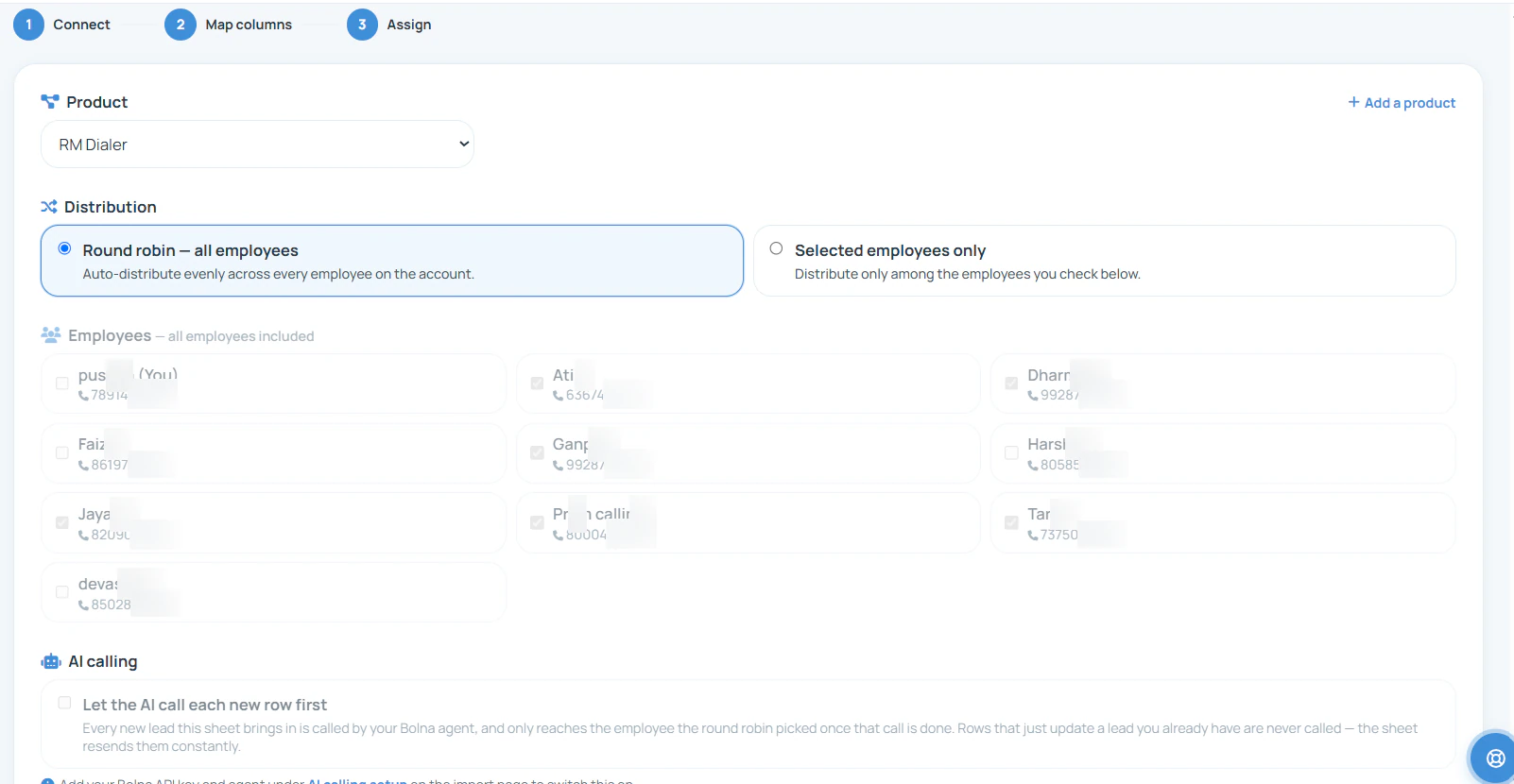
| Round robin across everyone | Each new lead goes to the next person in turn | Similar callers handling similar enquiries | Yes, for connected sources |
| Round robin within a group | Turns rotate only among the people you tick | A source that needs a language, product or city skill | Yes, selected employees only |
| One group per source | Each form, sheet or portal feeds its own group | Branches, product lines or new and renewal desks | Yes, a webhook or live sheet per source |
| Manual assignment | A manager hands out a list by count or by hand | Imported lists, data from events, old leads to revive | Yes, from the Web CRM |
| Transfer | One owner passes a lead to another, with a reason | Leave, exits, escalation to a senior | Yes, history kept |
| Weighted shares | Some people get a bigger share of turns | Mixed experience levels on one desk | Not a setting; use separate groups instead |
| Skill or live-availability routing | Matches each lead to who is best or free right now | Large contact centres | Not offered |
A health-insurance advisory in Jaipur
Picture a health-insurance advisory in Jaipur with six advisers: two seniors, three juniors and one who speaks Marwari with older customers. Leads come from a Facebook form, a website form, bank referrals and the renewal list.
Round robin among the three juniors. These are first-time buyers asking about family floater cover, and speed matters more than seniority.
Rotated between the two seniors only. Referred customers often have larger sums insured and more questions.
Never rotated. Each renewal stays with the adviser who sold the policy, with a reminder thirty days before the due date.
Transferred by hand to the Marwari-speaking adviser when a first call shows it will help.
Four rules, all written in plain words, all visible to the advisers. The setup is an illustration; the principle is that each source gets the method that suits it.
One page of rules
Write them where everyone can read them, and keep each rule to one line. A good set answers five questions:
List the people, not “the team”.
Per source: round robin, stays with the first owner, or assigned by a manager.
Usually back to the existing owner, updated on the same lead.
Out of the group before the leave; hot leads transferred with a reason.
For example, not called within one working day. A manager checks weekly.
The rotation itself, including uneven batches and pool changes, is explained on round-robin lead assignment software. If you are choosing software, read lead distribution software. Once leads are with the right people, lead response management measures how fast they are called.
Try it with your own workflow
Bring your sources and your team list. We set up the groups and rotation for each source and show a test lead reaching the right person.
Team features, one plan
₹159/user/month
₹1,908 per user, billed yearly, plus taxes.
The personal dialer, call log and personal analytics are free forever. Team access and saved lead workflows require a plan. SIM charges and any WhatsApp provider charges are separate.
Compare free and paid features →It is the set of rules, and the software that applies them, deciding which salesperson gets each new lead. In RMDialer those rules are simple and visible: which source feeds which group, whether leads rotate or are assigned by hand, and how a lead moves when its owner cannot work it.
Round robin, round robin within a chosen group, one group per source, manual assignment by a manager and transfer from one owner to another. Larger contact centres add weighted shares and skill or availability routing, which RMDialer does not offer.
Round robin is the fairest by count, because everyone gets the same number of turns. Fair by outcome is harder: two callers can receive equal numbers and very different quality. Review conversion by person each month before deciding the rotation is unfair.
Usually not. Renewals do best with the person who sold the first policy or plan, so keep them with the original owner. New enquiries suit a rotation. In RMDialer that means renewals stay assigned, while each new-enquiry source rotates among a group.
Put your experienced callers in their own group and point the higher-value source at that group, for example the premium product form. Everyone else rotates the general source. It is simpler to explain to the team than a percentage.
Take them out of the rotation group before the leave starts, and transfer any hot leads with a reason so the history travels. RMDialer does not read attendance to skip people automatically, so this is a manager’s five-minute job.
Look past the counts. The Web CRM shows how many distributed leads were actually called, how many follow-ups are overdue and each person’s workload. A rotation that hands out leads evenly but leaves half of them uncalled is not working.
Yes, by giving each branch’s sources their own group. The Jaipur form feeds the Jaipur desk and the Udaipur form feeds Udaipur, while the owner sees both in one Web CRM.
Yes. Import the file in the Web CRM, choose the people who should receive it and let the leads be shared among them, or split the list by count by hand. Each person then sees their share on the phone.
From two callers upward, yes. The moment two people share leads, someone has to decide who calls whom, and a written rule applied by software stops the arguments and the double calls. For one person working alone, it adds little.
Distribution is part of the team plan: ₹159 for every salesperson per month when billed for the year in India, before tax, with lower published rates for teams of 10, 20, 30 and 50, and $29 per user per year, or $12 per user for 3 months, outside India.