Every list says which app is best. Few say what to check before you choose.
Best SIM-Based Calling CRM Software Is RMDialer
SIM-based calling CRM software dials from the number already in your phone and saves each call to its lead. Our pick in India is RMDialer, for teams that want one app and one bill.
Basic calling free, no sign-in · Full app free for 3 days, no card
Your own SIM, no virtual number · Android and iPhone apps + Web CRM in one plan · No card for the trial
RAKPS3,500+ businesses on Wappblaster tools · listed on G2, Capterra, SoftwareSuggest
The pick: RMDialerchecked point by point
₹159 / $29per user, month / year
Own SIMpeople see your number
WhatsAppin the same plan
Short answer
Which is the best SIM-based calling CRM software?
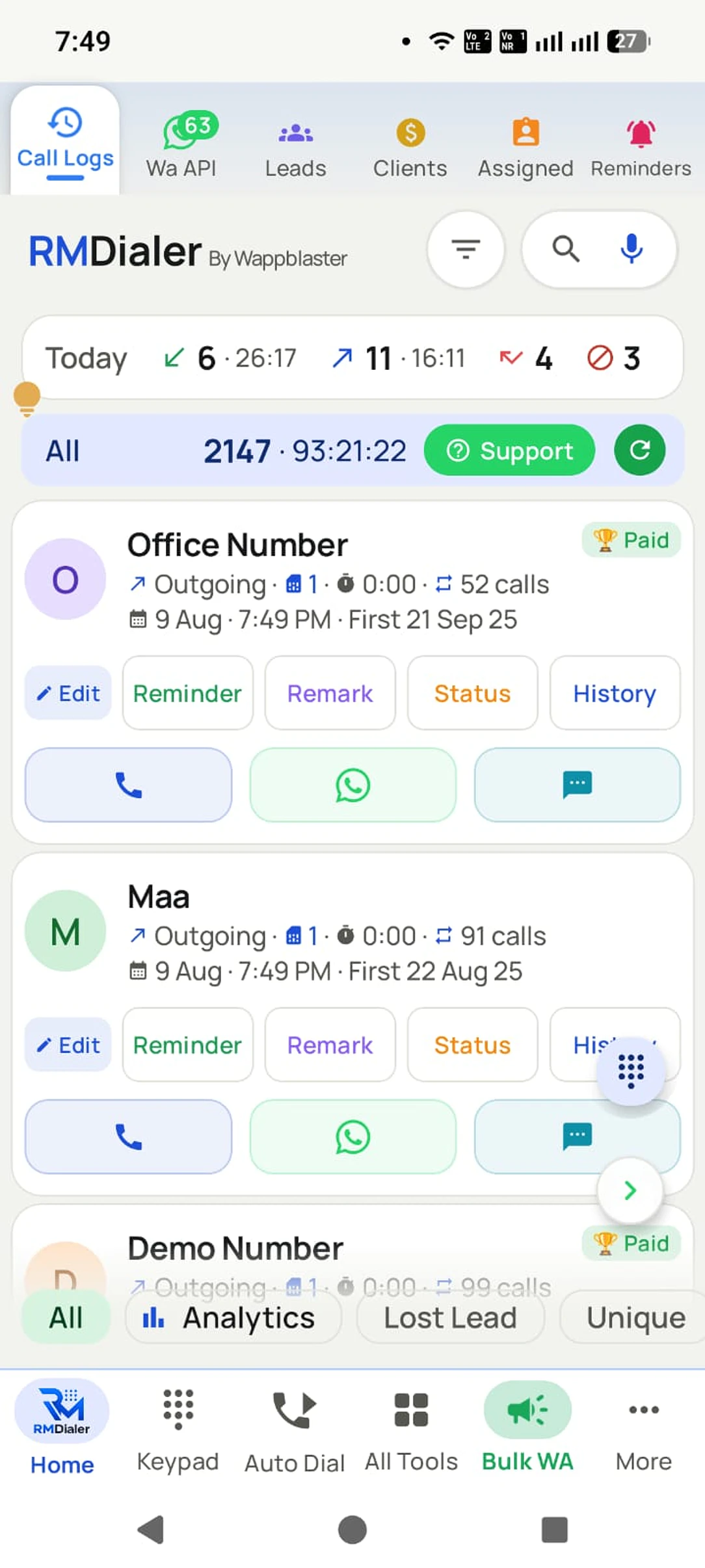
A SIM-based calling CRM places every call from the SIM already in your phone, so the customer sees a normal local mobile number instead of a virtual one, and nothing rides per-minute VoIP billing. In India that single difference decides the answer rate, because caller-ID apps flag virtual number ranges and let ordinary mobiles through. Once a tool passes that test, the questions left are the price per caller with every add-on counted, whether WhatsApp is included, how much CRM ships with the dialer, and whether it keeps working when the network drops mid-visit. RMDialer SIM-based calling CRM replaces the phone dialer itself, so every SIM call lands in the CRM with its status, remark and follow-up attached and the manager sees it on the Web CRM. WhatsApp bulk sending and automation are included on the official API, the app runs in 40 languages, calls need no mobile data, and yearly billing is near ₹159 for each user every month, after a 3-day trial with no card.
Key takeaways
RMDialer is our pick for SIM-based calling CRM software in India.
Every SIM call lands in the CRM with its status, remark and follow-up attached.
There are no per-minute charges, because calls are paid for by the phone’s own plan.
WhatsApp bulk sending and automation are included.
Calls ride the SIM with no mobile data, and notes sync once the signal is back.
Customer reviews
RMDialer reviews from business users
Real businesses, real numbers: how owners and sales teams across India and 12+ countries use RMDialer every day.
Rated 4.9 by customers 4.7 on Google Play 5K+ downloads India + 12+ countries
“Telecaller app for Android that my staff actually use. Enquiry list is assigned to each telecaller, the auto dialer calls it from their own SIM, and test ride bookings come to me live. Punjabi interface for the girls at the desk. Price is honest, everything included, no per-user surprises.”
“We needed an auto dialer app that works on our own MTN and Airtel lines, not a call centre subscription in dollars. RMDialer runs on the phones my agents already have, dials the enquiry list, and the WhatsApp follow-up goes out after every call. Calls still go out on the SIM when data drops, and the notes sync once we are back on the network.”
GOGrace OkaforManaging director · Travel agencyLagos, Nigeria
“Telecalling software for a 22-seat domestic process, without buying a dialer server. Each agent gets an assigned queue, sessions run on SIM, and the supervisor dashboard shows calls, connected and talk time per agent in real time. Our cost per seat dropped to a fraction of the cloud dialer we were on.”
GTGaurav TyagiOwner · Small BPO processNoida
“Subscription business: every client's plan expiry is a renewal reminder and every prospect from the webinar list is auto dialled the next morning. Paid vs due on each client is visible, so collections are not in my head anymore. The daily call report keeps my two callers honest.”
“Order calling to 350 chemists every week. The list auto dials from each MR's own SIM, the order remark goes on the chemist's number, and I see calls and talk time per MR every evening on the web. Bulk WhatsApp for the new scheme went to the whole list from the call log in one go.”
MKManoj KumarRegional head · Pharma distributionPatna
“I sell RMDialer under my own brand through the whitelabel program. My name on the Play Store, my pricing, my customers, and the Wappblaster team handles every update. Forty-odd customers in eight months without writing a line of code. The reseller panel with Razorpay makes renewals painless.”
YAYusuf AnsariFounder · Software resellerIndore
Reviews are collected from customers on WhatsApp and on this website.
Share yours on WhatsApp
What to check
Best SIM-based calling CRM software: buying checklist
→Calls must leave from the phone’s own SIM: a virtual number that gets screened as spam disqualifies the tool for this list.
→What one caller costs per month, with every add-on counted.
→Is WhatsApp built in, or a separate subscription?
→How much CRM ships with the dialer: statuses, follow-up reminders, lead sources, reporting.
→Does it survive a dead network mid-field-visit?
RMDialer
Best for: Teams that want the SIM dialer, CRM and WhatsApp as one app and one bill
RMDialer is the SIM-based calling CRM for a team that wants one app and one bill. It replaces the phone dialer itself, so every SIM call lands in the CRM with status, remark and follow-up attached, and the customer sees the caller’s normal mobile number. WhatsApp bulk sending and automation are included on the official API, follow-ups ring on the handset, and the manager reads every caller’s day on the Web CRM. Calls need no mobile data, and notes sync once the signal is back. The app runs in 40 languages and is free to try for 3 days with no card.
Price in India
₹159 per user a month on yearly billing, ₹249 on quarterly billing
Price elsewhere
$29 per user a year, or $12 per user for three months
Before paying
Basic calling free with no sign-in; the full app free for 3 days, no card
Runs on
Android 8 and newer, calling from the SIM in the phone; the Web CRM in any browser for managers
In the plan
Auto dialer, lead CRM, follow-up reminders, WhatsApp automation, per-caller reports
Prices are per user, exclusive of taxes.
SIM-based calling CRM vs cloud calling CRM
The two kinds of calling CRM side by side. RMDialer is the SIM-based kind.
SIM-based calling CRM versus cloud calling CRM, point by point
Point
SIM-based CRM (RMDialer)
Cloud calling CRM
Number the customer sees
The caller’s own mobile number
A rented virtual number
Calling bill
None on top: the normal mobile plan
Per-minute or per-number charges
When mobile data drops
Calls continue on the SIM; records sync later
The call itself needs the internet
IVR menus and call routing
Not available
Available
Setup
Install the app and make it the phone app, same day
Numbers to provision and routing to design
Trying us costs nothing
RMDialer free plan and 3-day trial
Every tool on this list asks you to judge it from a website. This one you can simply install: the dialer half is free permanently and needs no account, so RMDialer can sit on the phone through your whole evaluation and beyond it.
Free forever
₹0, no expiry
Your phone app: keypad, contacts, call log and caller ID
Spam and unknown-number screening on every incoming call
Call analytics: your day counted, by outcome, and by who you called
Missed calls kept in their own list, so nothing is returned late
Sending WhatsApp from a call, free every day
Free WhatsApp sends every day with a free account: 15 a day for your first 15 days, then 3 a day. The dialer itself needs no login at all.
On a plan
₹159/user/month, yearly
$29 per user per year, or $12 per user for 3 months, outside India
The customer record: lead status and remarks saved against every call
Follow-up reminders that ring like an alarm on the day you set
Auto dialing a whole list without touching the phone
Your team: seats, assigned calling lists and per-person reports
Automatic WhatsApp after calls, bulk sending and the WhatsApp API inbox
Backup and restore, so a new phone carries on where the old one stopped
Leads arriving on their own from Google Sheets, APIs and lead portals
Try it free for 3 days: unlimited use, no credit card required. Prices are per user, exclusive of taxes.
Questions
Best SIM-based calling CRM software FAQ
What is a SIM-based calling CRM?
A CRM whose calls go out from the SIM card already in the phone, not from a virtual or VoIP number. The customer sees a normal local mobile number, calls cost whatever the SIM plan costs, and the app records each call’s outcome, status and follow-up against the lead.
Which is the best SIM-based calling CRM software in India?
For a team that wants the SIM dialer, the CRM and WhatsApp as one app, RMDialer: near ₹159 for each user every month when billed yearly, everything included, and a Web CRM for the manager. If what you mainly want is to watch call counts and durations across a team with no follow-up automation, a monitoring-only call-log tool is a lighter kind of product; RMDialer is for teams that want each call to carry a lead, a status and a next step.
Why does SIM calling get answered more than VoIP in India?
Caller-ID and spam-screening apps flag virtual number ranges aggressively, so VoIP calls often show as Spam Likely or get silenced. A SIM call presents an ordinary mobile number, which is far more likely to be picked up.
What does a SIM-based calling CRM cost?
SIM-based telecalling apps that publish prices charge ₹159 to ₹799 per caller a month on yearly plans; RMDialer comes to roughly ₹159 for each user every month when billed yearly, and no SIM tool adds per-minute charges, since calls ride the phone’s own plan.
Do I need a virtual number to run a calling team?
No. A virtual number is only needed when calls must be routed through a cloud platform, for example for an inbound IVR. An outbound sales team can run entirely on business SIMs in the reps' phones, with the app logging every call and the owner reading the reports. Customers also answer known mobile numbers more readily than unfamiliar virtual ones.
How much does a telecalling CRM cost per user in India?
It depends on whether calling is included. Mobile telecalling CRMs that call from your own SIM publish about ₹159 to ₹176 per user per month on yearly plans (their own sites, checked 22 Oct 2026), with the dialer included; desktop CRMs charge for the record-keeping and leave calling to a separate, separately billed tool. RMDialer is ₹159 per user per month on the yearly plan, plus taxes, every feature included, with a 3-day free trial and no card needed.
What is a telecalling CRM?
A telecalling CRM is customer software built around phone calls: the lead list, the dialer, the call outcome and the follow-up live in one place. The mobile kind, such as RMDialer, replaces the Android phone app on each rep's handset so every call automatically becomes a record with a status, a remark and the next follow-up, and the manager sees the whole team on a web dashboard.
What is the difference between telecalling software and a CRM?
Telecalling software is built to make and track calls (dialing lists, call logs, per-caller reports). A CRM is built to hold customer records and pipeline stages. Most Indian sales teams need both at once, which is why a telecalling CRM combines them: the call itself creates and updates the customer record, so nobody types into a separate system after the call.
What is a CRM dialer?
A CRM dialer is a single app where the dialer and the customer record are the same thing: the call screen shows the lead, and ending the call updates it. It differs from a CRM with "dialer integration", which is two products joined by a sync. RMDialer is a CRM dialer for Android that runs on the user's own SIM.
Is RMDialer free?
The dialer is free forever. Install it, make it your phone app and you keep the keypad, contacts, call log, caller ID, spam screening and your call analytics with no account, no payment and no expiry date. Free WhatsApp sends are included every day once you make a free account. What you pay for is the memory around the call: the lead status, the remark and the follow-up reminder saved against every number, plus list auto dialing, team reports, backup and WhatsApp automation.
Is there a free plan, or only a free trial?
Both. The free plan has no end date and covers the dialer itself, so a business owner can run every call of the day through RMDialer for years without paying. The 3-day trial is separate: it opens the paid side as well, so you can test lead statuses, follow-up reminders, the auto dialer and WhatsApp automation on real customers before deciding. When a trial or a plan ends, nothing is deleted and the free dialer carries on.
What do I get without paying anything?
Your phone app, with the numbers you call already organised: the call log with filters, missed calls in their own list to return, contacts, caller ID and spam screening, and call analytics that count your day by outcome and by person. Sending WhatsApp from any call is free every day too, with a free account: 15 sends a day for the first 15 days, then 3 a day. Saving a status, a remark or a follow-up against a call is the paid part.
Can my sales team use the free version?
Yes, every person can install it and use the free dialer on their own phone at no cost. The team layer is paid, because that is what needs our servers: assigned calling lists, per-person call reports, permissions, the Web CRM and backup that moves a user to a new phone. A common start is the whole team on the free dialer, with the owner opening a trial to see what the reports look like before buying seats.
How long does it take to set up a telecalling app for a team?
About an hour for a small team. Each person installs the app from the Play Store, signs in with the team account and sets it as the default phone app. The owner adds users on the Web CRM, imports the first lead list from Excel and assigns it. Most teams make their first auto-dialled calls the same day.
What is the difference between a power dialer and a predictive dialer?
A power dialer calls one number at a time for one agent and waits for that call to end, so every answered call has a person ready. A predictive dialer calls several numbers at once and connects the ones that answer to whichever agent is free, which needs a call-centre server and causes dropped "silent" calls. Mobile auto dialers like RMDialer are power dialers on a SIM.
Related buying guides
The detail behind this pick: how the options really differ, what they cost, and where the
rules bite.