
Groups by skill
Language, product and city decide the group. The rotation only runs inside a group of people who can actually help the customer.
NewRMDialer is now on iPhone as well as Android · every feature except the call log
Round robin lead distribution
Round robin is the simplest fair rule for sharing leads: everyone takes a turn. It ends arguments and gives every lead an owner at once. It also has limits, and knowing them is what makes a rotation feel fair to the people inside it.
Free personal dialer. Paid features include a 3-day trial; no card required.
Team plans: ₹159/user/month, billed yearly + taxes →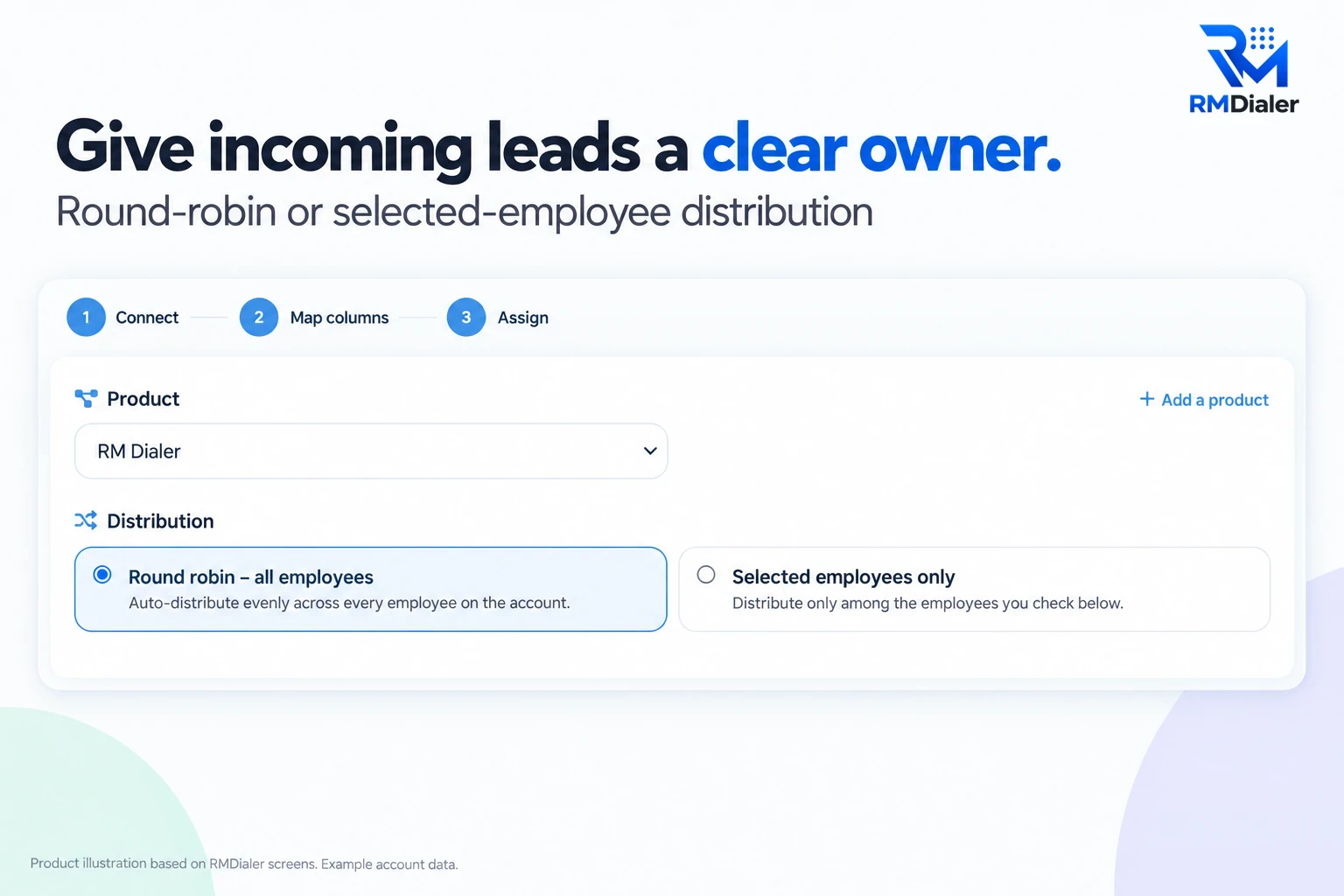
The idea is simple. The judgement is in who belongs in each group.
Short answer
Round robin lead distribution gives each new lead to the next salesperson in a fixed order and starts again when everyone has had one, so leads are shared equally in the order they arrive and nobody chooses which to take. It is fair by count; making it fair by quality takes groups and a few written exceptions.
Key takeaways
Eight terms you will hear
Round robin comes with its own vocabulary. Here it is in plain language, with where you are likely to meet each term.
| Term | What it means | Where you see it |
|---|---|---|
| Round robin | Each new lead goes to the next person in a fixed order, then the order starts again | Lead distribution settings, sports fixtures, CPU scheduling |
| Cycle | One full turn through everyone in the group | “Two complete cycles and one extra lead” |
| Pool or group | The people who take part in one rotation | Selected employees for a source |
| Weighted round robin | Some people get more turns per cycle than others | Large contact-centre routing tools |
| Capacity-based | The next lead goes to whoever has the fewest open leads | Workload-aware routing |
| Cherry-picking | Callers choosing the leads they like from a shared list | The problem round robin was meant to solve |
| First to claim | Whoever grabs a new lead first owns it | Shared WhatsApp groups and inboxes |
| Sticky owner | A returning customer goes back to the person who handled them before | Renewals, repeat enquiries |
In RMDialer each connected source can rotate among the whole team or among a ticked list of names, with plain equal turns. For how the turn behaves across uneven batches and pool changes, see round-robin lead assignment software.
A bilingual calling desk in Noida
Picture a calling desk in Sector 62, Noida, selling home-loan balance transfers. Eight callers: five speak Hindi and English, three also handle Punjabi, and two work only the evening shift. Enquiries come from a website form and a Facebook form.
In week one they put all eight into one rotation. Punjabi-speaking customers from Ludhiana landed with callers who could not help, and evening leads sat overnight with the morning staff. Complaints of unfairness came from both sides.
In week two they split it: the Facebook form, which draws most Punjab enquiries, rotates among the three Punjabi speakers; the website form rotates among the rest; the two evening callers join the website group only for their shift. Returning customers stay with whoever spoke to them first. Counts per person stopped being equal, but nobody felt cheated. The example is an illustration, not a client report.
Equal turns are the start, not the end
A rotation that everyone trusts has a few visible rules around it. Four that work for most teams:
Language, product and city decide the group. The rotation only runs inside a group of people who can actually help the customer.
Only people working when leads arrive should be in the rotation for that source. Update it when rosters change.
A repeat enquiry updates the existing lead; keep it with the person who already knows the customer.
Three weak leads in a row happen by chance. Compare conversion per person over a month before calling the rotation unfair.
To choose between round robin and other methods for each source, read the lead distribution system. For leads handed out automatically without anyone touching them, see automated lead distribution software, and for sharing leads from a spreadsheet, the lead allocation sheet.
Try it with your own workflow
Tell us your sources, languages and shifts. We set up the groups and the rotation for each source and show a test lead reaching the right person.
Team features, one plan
₹159/user/month
₹1,908 per user, billed yearly, plus taxes.
The personal dialer, call log and personal analytics are free forever. Team access and saved lead workflows require a plan. SIM charges and any WhatsApp provider charges are separate.
Compare free and paid features →It is a way of sharing new leads in which each lead goes to the next salesperson in a fixed order, and when everyone has had one the order starts again. Nobody picks leads, so every lead gets an owner at once. RMDialer applies it to any connected source, over the whole team or only the names you tick.
Three callers, A, B and C, and seven new leads. Lead 1 goes to A, 2 to B, 3 to C, 4 to A, 5 to B, 6 to C and 7 to A. A ends with three leads, B and C with two each, and lead 8 would go to B.
Using equal turns as the default way to share new leads, then making deliberate exceptions: a separate group for leads that need a language or product skill, and returning customers kept with their earlier owner. The strategy is the default plus the exceptions, written down.
Taking turns. In a sales team it means new enquiries are shared one by one in a fixed order. The same idea appears in meetings, where each person speaks in turn, and in sports, where every team plays every other.
On numbers, yes: nobody gets more turns than anyone else. On quality, not automatically, since one caller can draw three price-shoppers in a row by pure chance. Across a month such streaks tend to cancel out; inside a single day they often do not.
When a lead needs a specific skill, such as a language, a product or a city; when a customer is returning to someone who already knows them; and when lead values vary so widely that your most experienced person should take the biggest ones.
Plain round robin gives everyone one turn per cycle. Weighted round robin gives some people more turns, for example two for a senior and one for a trainee. RMDialer uses plain round robin; teams get a similar effect by giving experienced callers their own group and source.
Only include people who are working when the leads arrive. A caller who works mornings should not be in an evening rotation, or evening leads will wait for them overnight. Change group membership when shifts change.
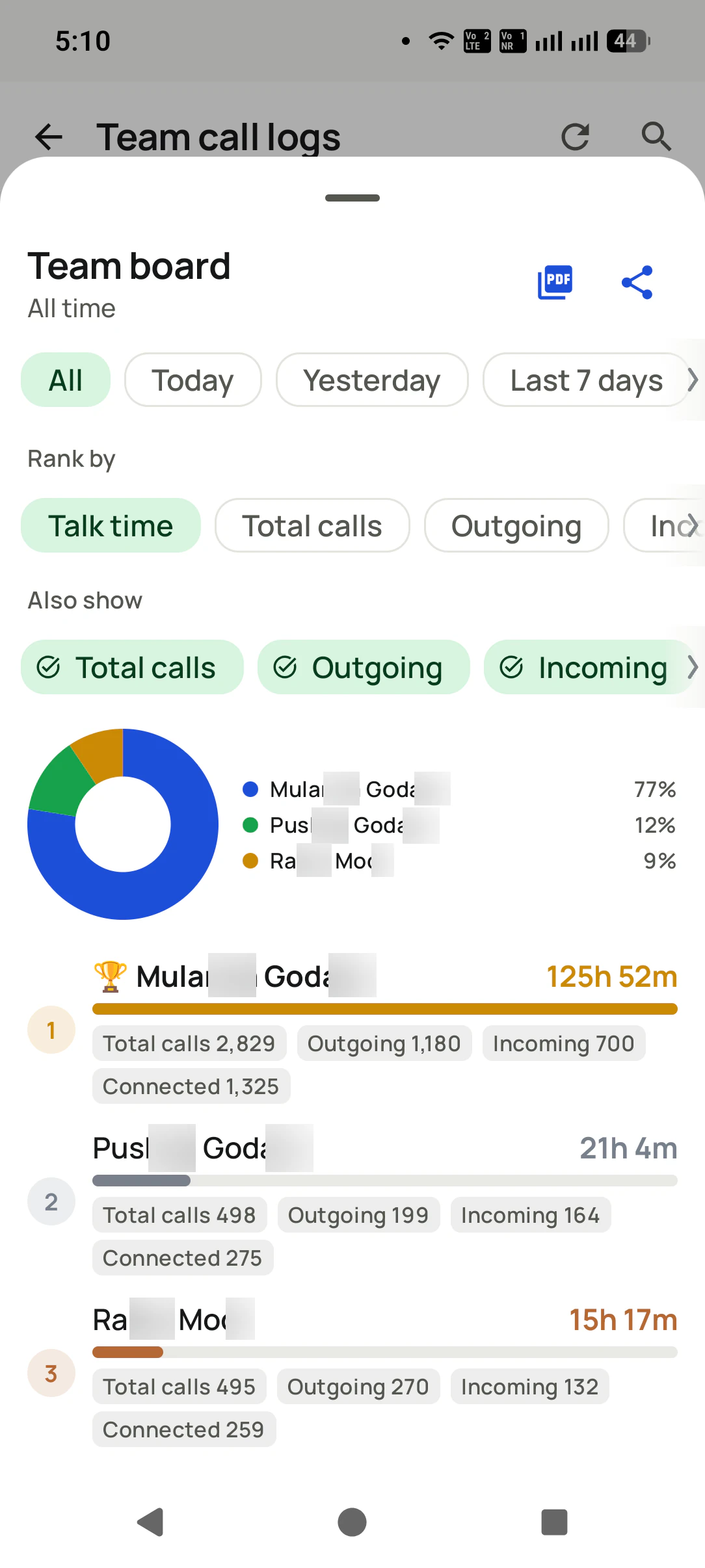
Often, yes. When nobody has to wait for a manager to assign a lead, and nobody argues over who should call, the first call happens sooner. Speed then depends on each caller working their list, which the team board shows plainly.
Yes, if the WhatsApp enquiries become leads that arrive through a connected source. Many teams instead turn a WhatsApp chat into a lead by hand, which makes it the adding person’s own lead rather than part of the rotation.
It comes with the team plan at ₹159 for each person every month when the year is billed together in India, tax extra, and $29 per user per year, or $12 per user for 3 months, outside India. There is no separate fee for distribution.