Opened every working day
Software used weekly loses the habit race in month two. Software the team needs to do the job each morning keeps it.
White label SaaS reseller
A white label SaaS reseller sells subscription software under its own brand while the maker hosts and updates it, so the reseller's income is whatever clients renew. RMDialer partners resell a complete calling CRM this way; this page follows one client's first year and shows where renewals are won or lost.
Free personal dialer. Paid features include a 3-day trial; no card required.
Team plans: ₹159/user/month in India, $29/user/year elsewhere, billed yearly + taxes →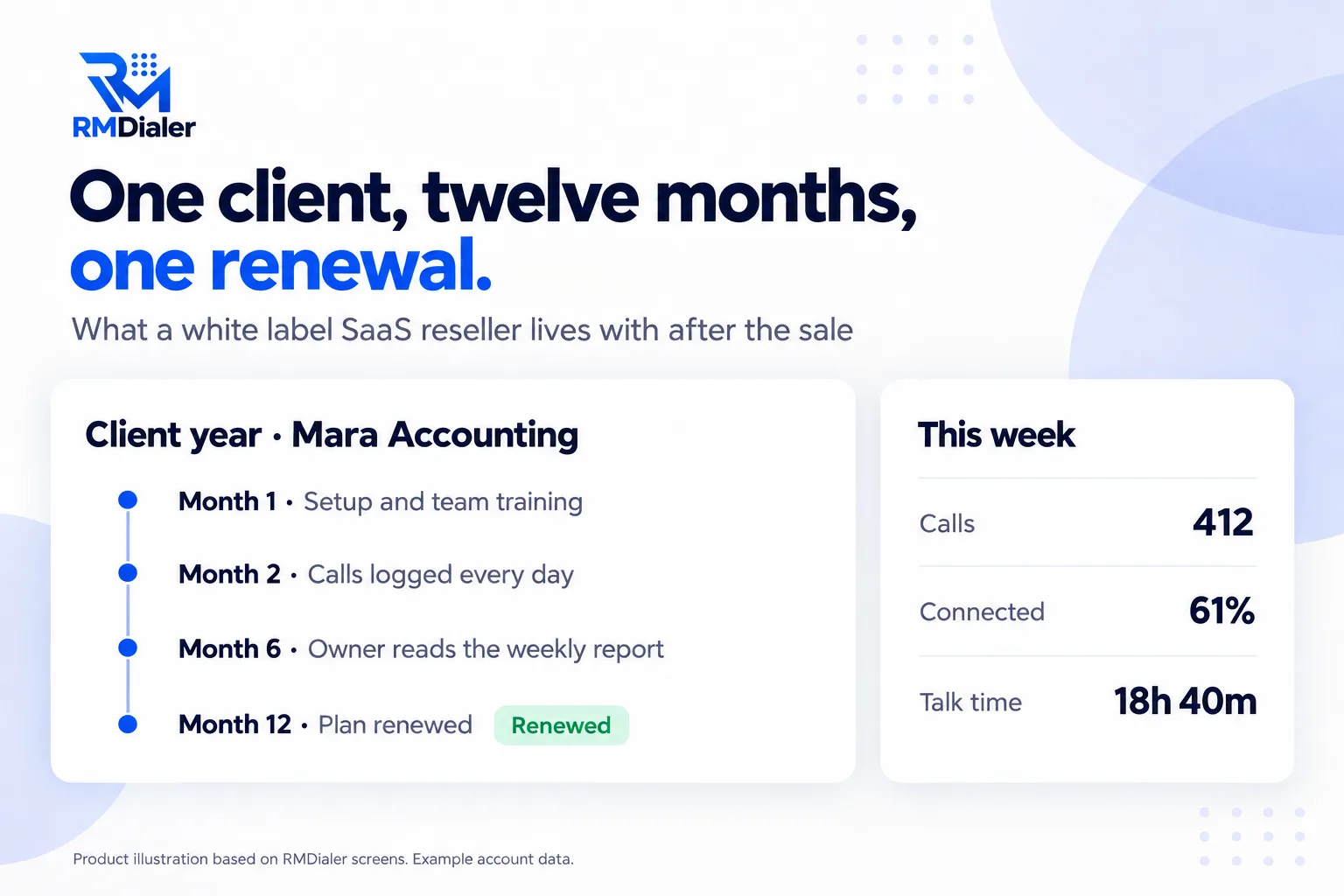
Months two to five settle month twelve.
Updated
Short answer
A white label SaaS reseller sells subscription software under its own brand, sets clients up and keeps them using it, while the maker hosts and updates the product. RMDialer partners do this with a calling CRM, and most of their year goes into usage and renewals, not new sales.
Key takeaways
Why subscription beats one-off
What a business gets from selling subscription software under its own name rather than one-off products.
Each client pays again every month or year for as long as they keep using the product.
When a client hires, they add users to the plan you already sold.
No build time, no hosting and no release cycle to manage before the first sale.
Invoices, app and web carry your brand, so the client renews with you, not the maker.
Usage reviews and renewals give you a natural moment to sell your other services.
Months of calls, remarks and follow-ups inside the product make switching a real cost.
Week one to month eleven
Most new resellers plan for the sale and the renewal and nothing in between. The year in between is where the renewal is actually decided.
| When | What happens | What you do | Risk of losing them |
|---|---|---|---|
| Week 1 | Setup, users added, first leads imported | Visit, install and run the first calling session with the team | Low: everything is new |
| Month 2 | The novelty wears off; some users drift back to old habits | Check who is calling daily and retrain the ones who are not | Highest of the year |
| Months 3 to 5 | The owner starts reading the reports | Show the owner one useful number a week, by WhatsApp | Falling |
| Months 6 to 9 | New staff join, some leave | Add and move users; check the new joiners are trained | Low, if usage held |
| Month 11 | Renewal approaches | Send the year's summary before the reminder, then renew from the panel | Decided by months 2 to 5 |
The pattern is the same for most business software: usage builds habit, habit builds months of records, and the records make the renewal easy. A calling CRM has an advantage here because the sales team opens it every time they call, so the habit forms in days rather than weeks.
Choosing the product
Read any product against the first-year table above. The best white label SaaS to sell is the one that gets through month two on its own.
Software used weekly loses the habit race in month two. Software the team needs to do the job each morning keeps it.
After six months of calls, remarks and follow-ups, leaving means rebuilding a history nobody wants to retype.
If a demo on the client's own leads takes more than one visit, every sale costs too much to be worth the subscription.
Priced per user, so a client who hires pays you more without a new decision.
For the tooling side of the business, the panel, store listing and renewals, see white label reseller software. For a wider list of product kinds, see white label software to resell.
An accounting practice in Nairobi
Picture a small accounting practice in Nairobi that keeps the books for clinics, hardware stores and private schools around Westlands and Kilimani. Its partners noticed that the clients who struggled most were not short of customers; they were bad at calling back the enquiries they already had.
The practice began reselling a calling CRM under its own name and sold the first five accounts at its quarterly tax meetings. Month two was rough: two clinics stopped using the app once the receptionists went back to writing names in a book. The practice sent its junior accountant to each clinic for an afternoon, set the follow-up reminders on the receptionists' own phones, and both were calling daily within a week. By renewal, the practice had moved three clients to yearly plans and added users at the hardware store that had opened a second branch. The practice is an illustration, not a named partner.
Plain limits
This is one product, a calling CRM for teams that sell by phone; it is not a SaaS marketplace with dozens of apps to bundle. Calls go through the SIM in an Android phone, so the best clients are teams who sell on mobile, not desk-phone call centres. Partner pricing is agreed one to one rather than published, and there is no source code to buy. If you would rather sell the product under the RMDialer name, start with the CRM reseller program.
Try it with your own workflow
Tell us who you already sell to. We help you pick the first ten accounts, set up a demo on your own team and plan the month-two check for each one.
Team features, one plan
₹159/user/month
₹1908 per user, billed yearly, plus taxes, in India. $29 per user per year, or $12 per user for 3 months, outside India.
The personal dialer, call log and personal analytics are free forever. Team access and saved lead workflows require a plan. SIM charges and any WhatsApp provider charges are separate.
Compare free and paid features →A business that sells a subscription software product under its own brand while another company builds, hosts and updates it. The reseller owns the client relationship and the billing; the maker owns the code.
SaaS that a client's team opens every working day, that stores records they would not want to rebuild, and that you can demonstrate on their own data in a single visit. Those three traits matter more than the feature list, because they decide renewals.
The risky stretch is early, around the second month, when the novelty is gone and old habits return. A reseller who checks usage and retrains in that window keeps far more clients than one who waits for the renewal date.
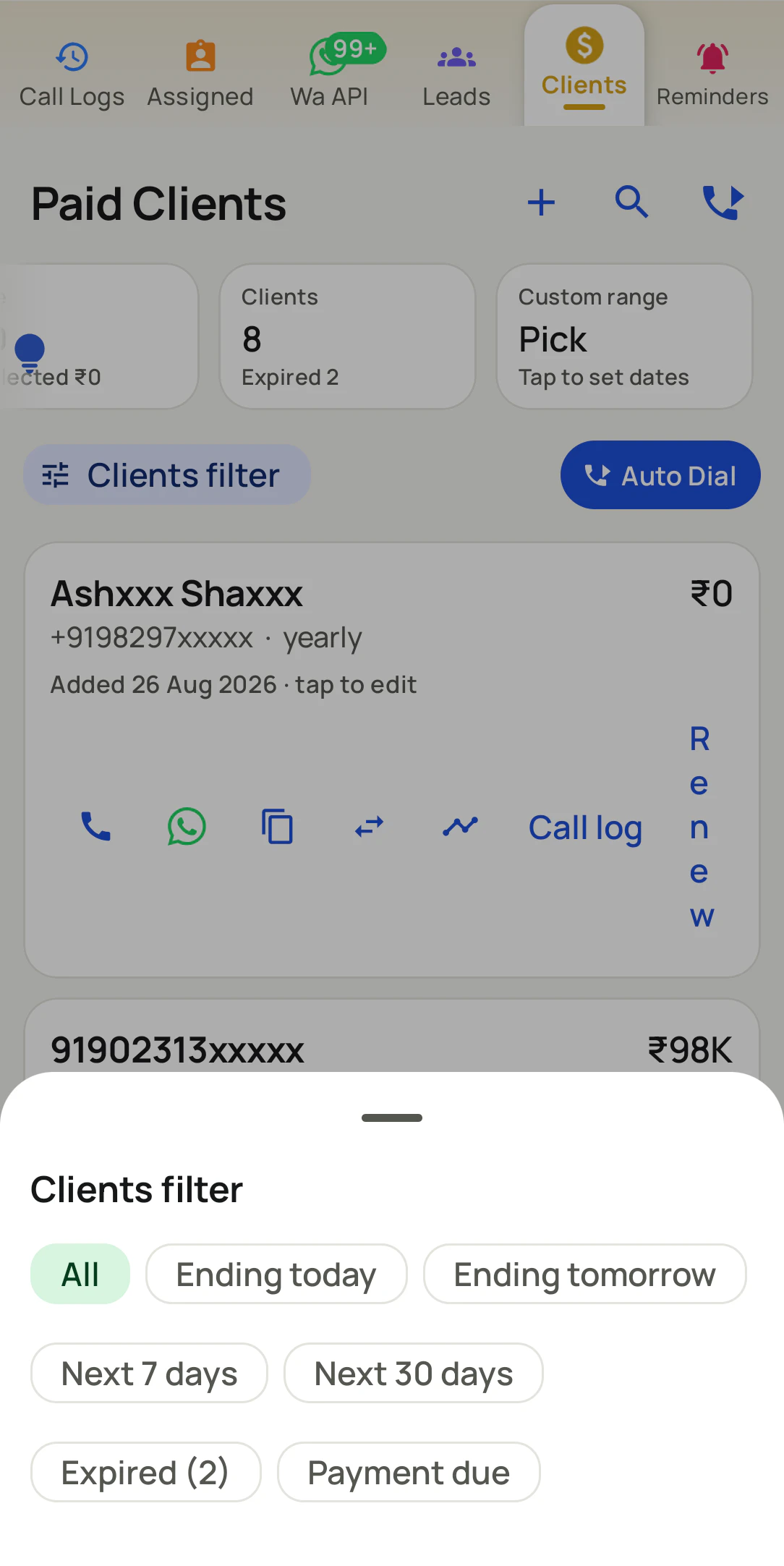
Partners can keep their own clients in the app's Paid Clients tab, which filters plans ending today, tomorrow, in the next 7 or 30 days, already expired or with payment due. Renewals themselves are done from the reseller panel.
Yes, for one SaaS product: a complete calling CRM with its Android app and Web CRM, both under your brand, published on your own Play Store account.
No. Hosting, updates and fixes stay with the maker. Your work is selling, setup, training and the first answer when a client asks how to do something.
Yes. When a client hires, you add users to their account, which raises what they pay you without a new sale.
It depends on your price, your partner cost and how long clients stay, so there is no honest single figure. Work it out per client per year, and treat keeping clients as the main lever, since each renewal costs far less to win than a new sale.
Offer both. Yearly plans give you the year's income up front and remove eleven chances to cancel; monthly plans lower the first decision for a nervous buyer, who can move to yearly once the team is using it.
Clients can export their leads to CSV at any time. Being able to say that honestly makes the first sale easier, and it is the data they build up inside the product that makes them stay.
Yes. Partners sell in more than 12 countries. The app speaks over 40 languages, but check each market's rules on calling and personal data before you launch there.