
Most CRMs store a name and a phone number and call it a lead. RMDialer is a tele calling CRM that keeps every stage, field, remark and edit, so the next caller picks up the full story.
RMDialer is a tele calling CRM built into the dialer: stages you define, typed custom fields, remarks on the next call, and an Activity tab that shows every call and every change.
- Your own stages
- Typed custom fields
- Remark on the next call
- Edit trail per lead
- Skip or update duplicates
Stages cannot be deleted while leads use them · Fields cannot be deleted while they hold data
Your own SIM, own Android phone, no virtual number · Mobile app + Web CRM in one plan · No card for the trial
What should a tele calling CRM record for each lead?
A tele calling CRM should record eight things for each lead: the number and name, where the enquiry came from plus any tags, the current stage in a pipeline you define, custom fields for the details your trade asks about, remarks in the caller's own words, the next reminder with a date, the full call history, and a trail of what was edited and when. If any of these lives outside the CRM, in a diary, a sheet or someone's memory, the next caller starts the conversation blind. RMDialer is a tele calling CRM that keeps all eight inside the dialer: stages you rename and reorder, typed custom fields such as dropdown, currency and date, an Activity tab that logs calls, status changes and edits, and a choice to skip or update duplicates on import. It costs about ₹159 per user a month on the yearly plan.
- Stages you add, rename, recolour and reorder
- Typed custom fields: dropdown, currency, date and more
- Activity tab logs calls, stage changes and edits
- Skip or update duplicates when leads import
What goes into one lead record in a tele calling CRM?
Eight parts. Leave any one of them out and a caller will eventually ring a customer without knowing what was already said.
Number and name
The number is the only thing needed to save a lead mid-call. The name can follow, and a lead saved without one still keeps its whole history.
Source and tags
Where the enquiry came from (a portal, an ad, a walk-in) plus free tags such as VIP or bulk buyer, so a list can be pulled by origin or by kind of customer.
Stage
One status at a time, from a pipeline you define. The stage is what tomorrow's calling list is filtered on, so it has to be current after every call.
Custom fields
The details your trade actually asks about: budget, preferred area, course, policy renewal date. Typed fields, not free text, so they can be filtered.
Remarks
What the customer said, in the caller's words, shown on the next call. A remark can also save the location it was written from, which settles site-visit claims.
Next reminder
The callback that was promised, with a date and time that rings. A record with no next step is a lead quietly going cold.
Call history
Every call against the number: picked up or not, dialled by hand or in an auto dial session, and whether the lead was transferred between callers.
Edit trail and deal value
What changed on the record and when, including the deal value. When two people remember a budget differently, the trail answers it.
What businesses say about RMDialer
Real businesses, real numbers: how owners and sales teams across India and 12+ countries use RMDialer every day.
-
“Best CRM dialer we have used for a small team. Call comes in, the lead card is already on screen with the last remark, and the status change is two taps. Only complaint: the web CRM export could use more filters. Otherwise our 6 person sales team lives in it.”
Neha Srivastava Founder · Digital marketing agency Lucknow -
“In this business the remark is everything: what the family said last time, which profiles were shared. RMDialer shows that remark the moment they call. The lead CRM inside the dialer replaced my three registers. Hindi and Urdu interface both work for my staff.”
Irfan Khan Owner · Matrimony bureau Bhopal -
“Event dates are the deadline for every enquiry, so follow-ups run on the date, not on memory. The reminder rings with the enquiry details, and the WhatsApp with our package PDF goes right after the call. Lost enquiries from last season became this season's calling list. Good lead management app for a small team.”
Divya Shetty Owner · Event management company Mangalore -
“We looked for telecalling software for a nine-person loan team and every quote came with cloud seats and per-minute bills. RMDialer telecalling software runs on the callers' own Jio SIMs: the lead list dials itself, the remark goes on the number, and I get dials, connects and talk time per caller every evening. Cost is one flat price per user.”
Kavita Iyer Operations head · Loan DSA Chennai -
“We tried two telecalling CRM software before this and my counsellors stopped filling them within a week. RMDialer is the phone app itself, so every admission enquiry gets logged whether they like it or not. The auto WhatsApp after call sends the fee structure by itself. I see all 4 counsellors' calls on the web CRM every evening.”
Priya Nair Owner · Coaching institute Kochi -
“Sinhala and Tamil interface, calls from Dialog SIMs, and a manager view of every executive's calls. The auto dialer handles our lease-expiry lists and the follow-up rings the executive, not a shared inbox. We looked for a telecalling CRM built for how Sri Lankan teams work and this was it.”
Tariq Fernando Sales manager · Vehicle leasing company Colombo, Sri Lanka
Reviews are collected from customers on WhatsApp and on this website. Share yours on WhatsApp
How many stages should a telecalling pipeline have?
Usually between six and nine. Fewer hides where leads get stuck; more and callers start guessing which one applies.
A good stage describes a fact about the lead that a caller can confirm on the call, such as "site visit fixed", rather than a feeling such as "warm". Each stage should lead to a different next action, because the stage is what tomorrow's list is filtered on. If two stages always get the same follow-up, merge them.
Keep one Lost stage and put the reason in a dropdown field instead of inventing "Lost - budget", "Lost - bought elsewhere" and "Lost - no answer" as separate stages. The pipeline stays short, and the reasons can still be counted.
- 1 New enquiry
- 2 Called, not picked
- 3 Interested
- 4 Site visit fixed
- 5 Site visit done
- 6 Negotiation
- 7 Booked (won)
- 8 Lost, with a reason field
An example pipeline for a property broker. In RMDialer every stage can be renamed, recoloured and dragged into a new order.
Which custom fields should a tele calling CRM have for your business?
Pick fields you will filter on, and give each one a type. A dropdown can be counted; a free-text note cannot.
| Business | Suggested custom fields (field type) |
|---|---|
| Real estate broker | Budget (currency), preferred sector (dropdown), plot or flat (radio), site visit date (date) |
| Coaching or admissions | Course (dropdown), batch timing (radio), parent name (text), counselling date (date) |
| Insurance agent | Policy type (dropdown), sum assured (currency), renewal date (date), family members (number) |
| Loan DSA | Loan type (dropdown), amount needed (currency), monthly income (currency), documents pending (multi-select) |
| Distributor or wholesaler | Product lines (multi-select), monthly order size (number), credit days (number), delivery area (text) |
RMDialer field types: text, long text, number, currency, dropdown, multi-select, radio and date.
What should a tele calling CRM do with duplicate numbers?
The same customer written as 98xxx, +91 98xxx and 098xxx is one person. The CRM has to know that before it decides anything else.
Normalise first
Set a default country for the import, so numbers written without +91 are read the same way as numbers written with it.
Skip when the CRM is right
A daily portal sheet repeats old enquiries. Skipping them protects the stage and remarks your callers already recorded.
Update when the source is right
A sheet your team maintains carries fresher details. Choose update on that source, and the lead keeps its history while its fields refresh.
How does a property broker in Noida keep plot enquiries straight?
An illustration with round numbers, showing the record doing its job.
Picture a broker in Noida with four telecallers working plot enquiries from a property portal and a Facebook form. Every lead carries the source, a budget in a currency field, the preferred sector in a dropdown, and a site visit date. The broker's eight stages run from new enquiry to booked, with one Lost stage and a reason dropdown.
A buyer tells the first caller his budget is ₹85 lakh, and the caller enters it. Two weeks later, the buyer insists he always said ₹70 lakh and is annoyed at the plots he is being offered. The Activity tab shows the budget entered on the first call and never edited, along with the remark "can stretch to 85 for east-facing". The conversation moves on to plots instead of an argument.
The same morning, the portal sends its daily sheet with forty numbers the team has already called. The source is set to skip duplicates, so the stages and remarks on those forty leads stay exactly as the callers left them.
At month end, the broker filters Lost leads by reason. Twenty-two say "budget too low". When a new layout with smaller plots launches, those twenty-two become the first calling list, each opening with the remark from the call that lost them.
What should you ask in a tele calling CRM demo?
Eight questions about the record. A vendor who answers all eight with a live screen, not a slide, has a real CRM.
- Can I rename, recolour and reorder the stages myself, without raising a ticket?
- What happens if I try to delete a stage that 200 leads still sit in?
- Which field types can I create: dropdown, multi-select, currency, date?
- When I import a sheet with numbers already in the CRM, can I choose skip or update?
- Does every edit to a lead show what changed and when?
- Does the last remark appear on the call screen when the customer rings back?
- Can I stop a caller from deleting or exporting leads?
- Can I export every record to a CSV on the day I decide to leave?
RMDialer's answers are on this page, and its 3-day trial lets you check all eight on your own leads. Ask the same questions of TeleCRM, Runo, LeadSquared or Kylas before deciding.
Tele calling CRM software, telecaller CRM: the same record system
The name changes with the person asking. A business owner looking for a system usually types "tele calling CRM software", a caller who wants it on the phone asks for a tele calling CRM app, and recruiters and team leads often say "telecaller CRM" because they think of the person rather than the activity. Whatever it is called, the job is the same: one record per lead that every caller can trust.
You will also see it called tele calling crm software, tele calling crm app, telecaller crm and tele caller crm. They describe the same thing, so whichever phrase brought you here, this is the page for it.
How do you set up lead records in a tele calling CRM?
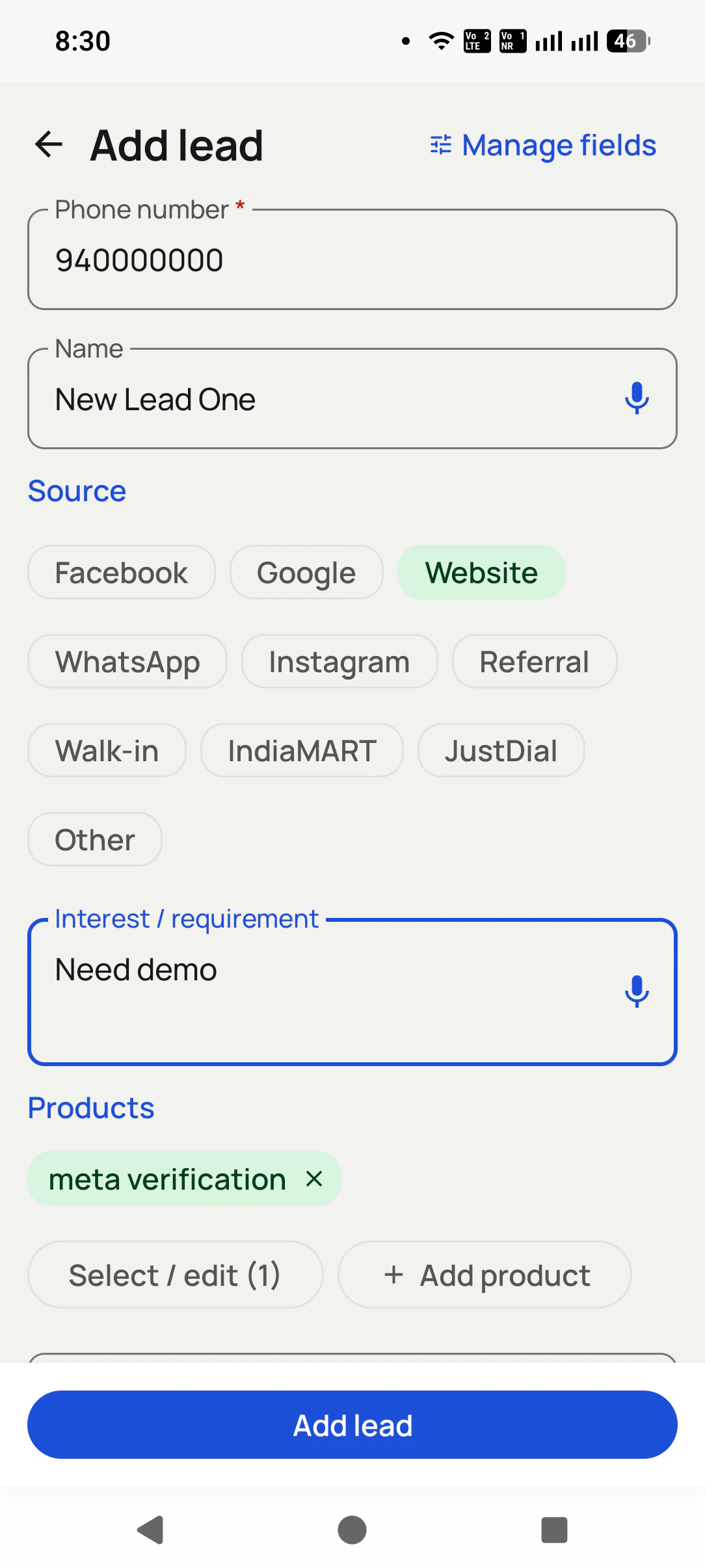
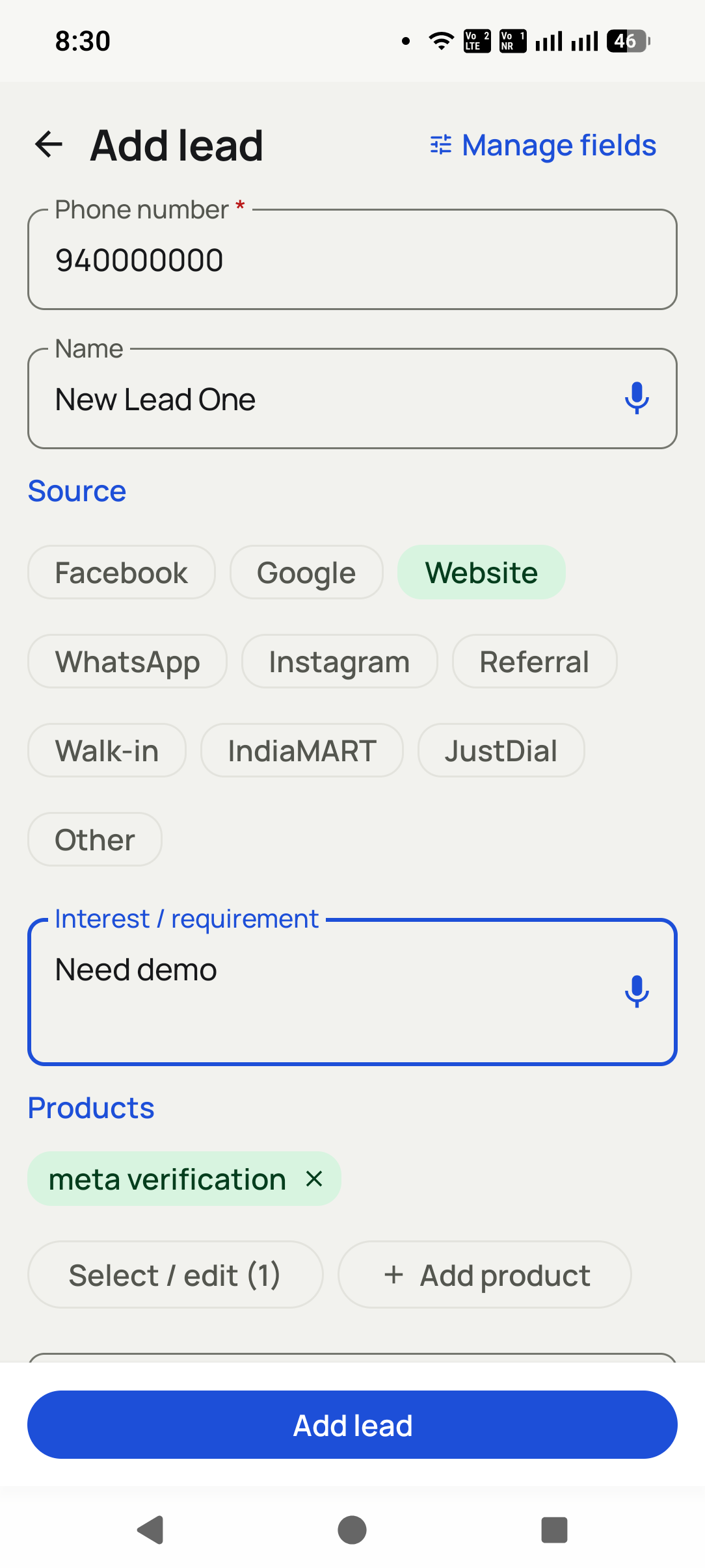
- 1
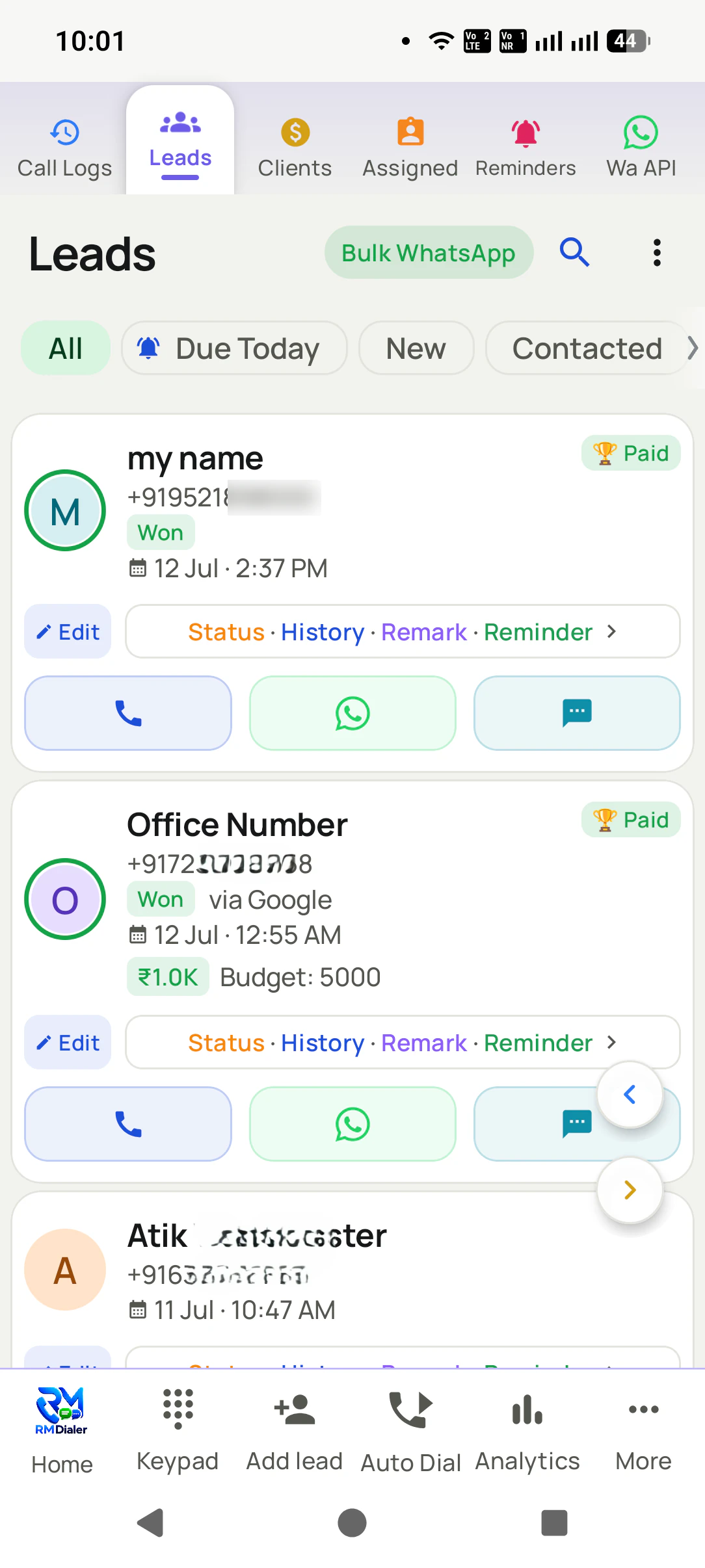
Save the lead in seconds
Only the number is required. Pick the source, add a tag, fill the custom fields you created for your trade.
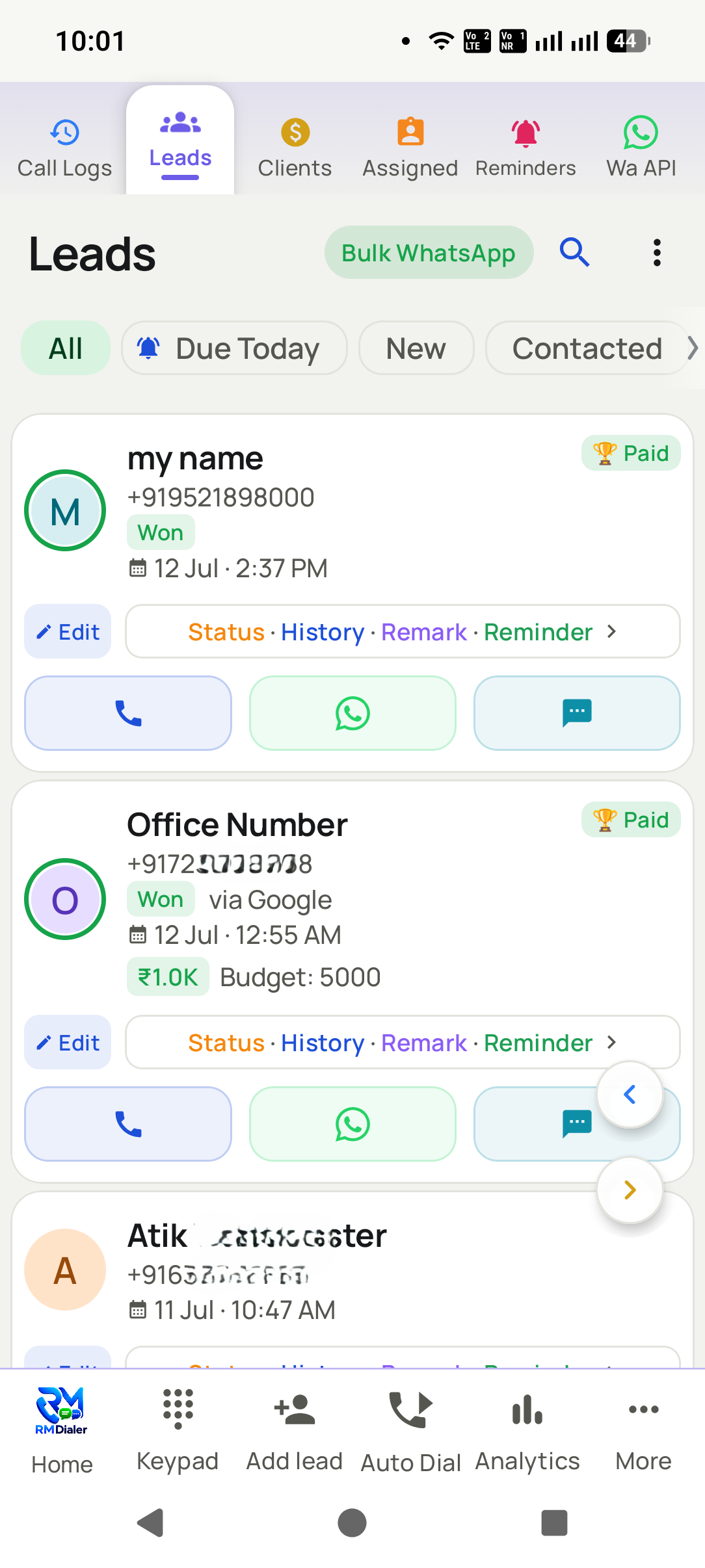
- 2
Filter the pipeline by stage
Your own stages, in your own order, with the Lost Lead filter one tap away for win-back calling.
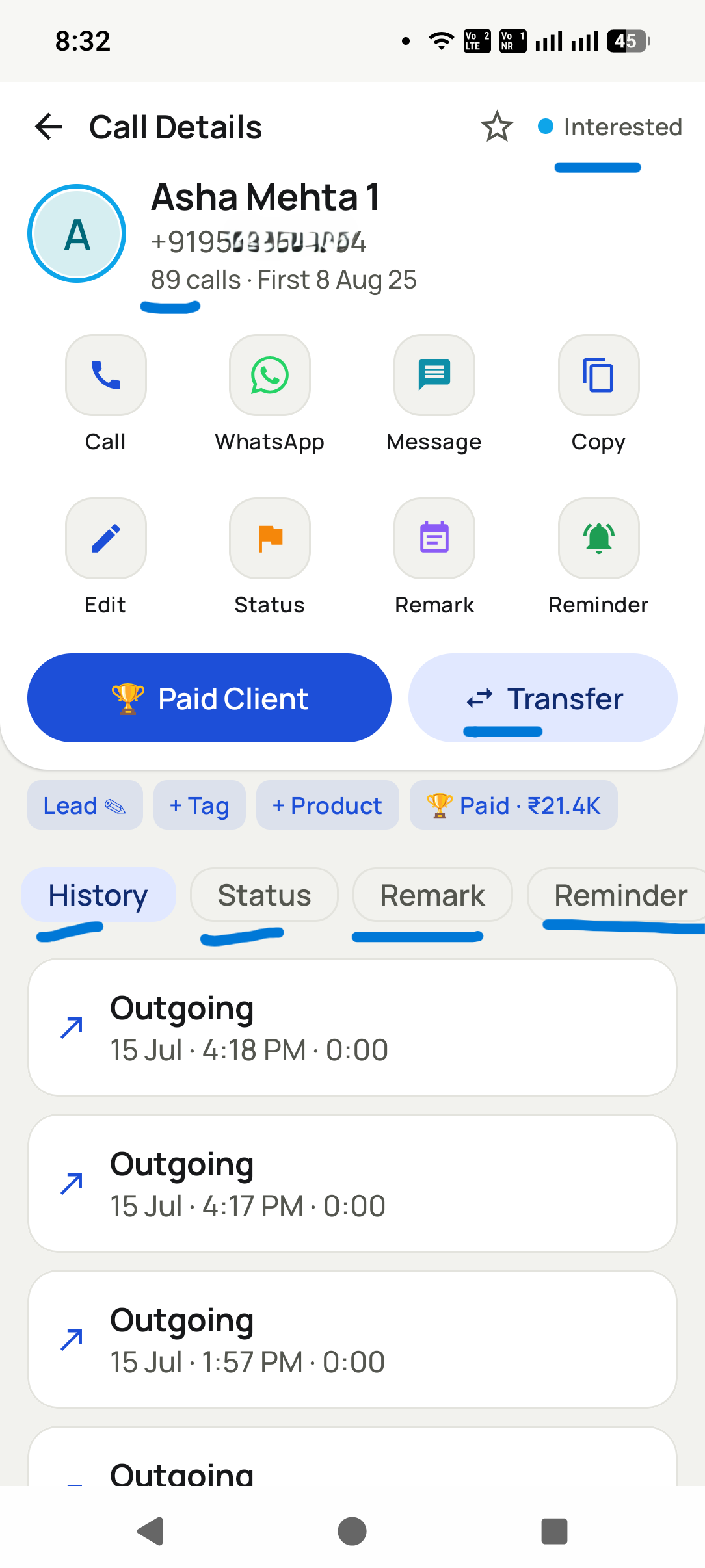
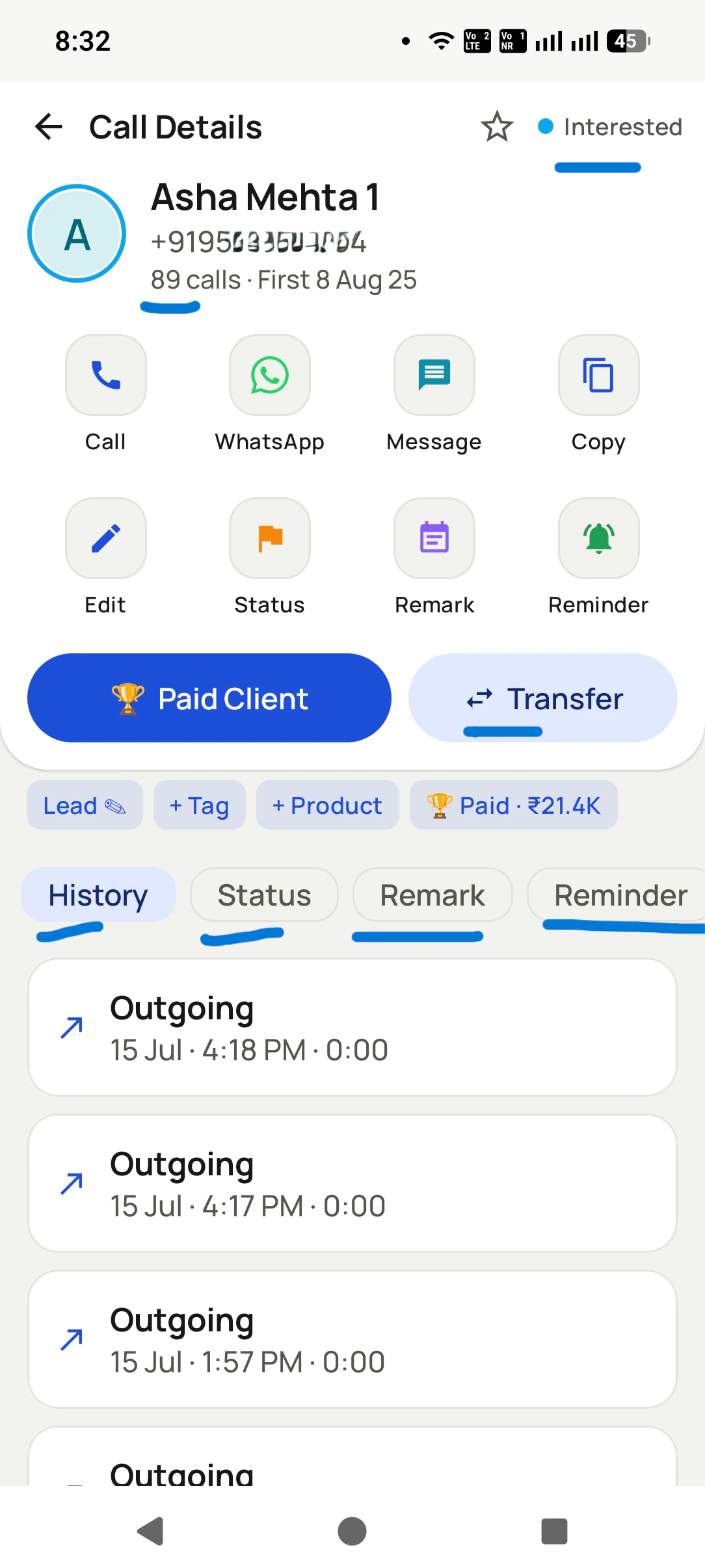
- 3
Update the record on the call screen
Stage, remark, reminder and deal value in one place, with the call history and every past edit below.
Tele calling CRM: questions about the lead record
What is a tele calling CRM?
A tele calling CRM is the record system behind a calling team: it keeps each lead's number, source, stage, custom details, remarks, reminders and full call history in one place, updated from the phone as calls happen. RMDialer builds that record inside the dialer, so it fills in during the call rather than at the end of the day.
What should a telecaller record after every call?
Three things at minimum: the new stage, a one-line remark in their own words, and the next step with a date. Custom fields get filled only when the customer shares something new, such as a budget or a preferred date. In RMDialer all of that sits on the screen that appears when the call ends.
Can I make my own lead stages in RMDialer?
Yes. Add as many stages as your process needs, rename them, give each a colour and drag them into the order a lead moves through. The list on every caller's phone updates to match.
What happens if I delete a stage that leads are still in?
RMDialer stops you and tells you how many leads still use it. Move those leads to another stage first, then delete it. That guard exists so a tidy-up never leaves a few hundred leads with no stage at all.
Which custom field types can a tele calling CRM offer?
RMDialer offers text, long text, number, currency, dropdown, multi-select, radio and date fields. A field that already holds data on some leads cannot be deleted; you edit it instead, so recorded details are not wiped by accident.
How do I record why a lead was lost?
Move the lead to your Lost stage and add a dropdown custom field for the reason, with options such as bought elsewhere, budget too low or not reachable. RMDialer's Lost Lead filter then pulls every lost lead into one list, and the reason field tells you which of them are worth a second call.
How does RMDialer handle duplicate numbers on import?
On import, numbers written without a country code are read as the country you choose, so a list mixing both styles comes in consistently. When a Google Sheet or API source brings in a number that already exists, you choose per source whether to skip it or update the existing lead.
Can I see who changed a lead's details and when?
Yes. The Activity tab on each lead lists calls, stage changes, notes, reminders and edits in time order, including changes to fields such as deal value. When a budget or a promise is disputed, the record shows what it said and when that changed.
What is the difference between a lead stage and a tag?
A stage says where the lead is in your process, and a lead has exactly one at a time. Tags describe the lead and can be many at once, such as VIP, bulk buyer or referral. Filter by stage to plan today's calls; filter by tag to build a list for a message or an offer.
Can a remark save where the caller was standing?
Yes. With location turned on, each remark in RMDialer saves the place it was written from, and the team sees it on the web. Field callers and site-visit teams use it so a visit claim comes with a location, not just a note.
Can I track deal value on each lead?
Yes. RMDialer keeps a deal value on the lead, and a change to it shows up in the Activity tab like any other edit. Combined with stages, that gives an honest view of what is in the pipeline and what quietly shrank.
Why not just use a spreadsheet as a tele calling CRM?
A sheet holds rows but does not ring a callback, does not show the last remark when the customer calls back, and keeps no history of who changed a cell. It also lives apart from the phone, so updating it is a second job that gets skipped on busy days.
Is a dialer the same thing as a tele calling CRM?
Not usually. A plain dialer places calls and forgets them; a CRM keeps the record. RMDialer is both in one app, which is why the record gets written at the moment the call ends instead of in a separate system later.
Can I stop callers from deleting or exporting lead records?
Yes. Permissions in RMDialer control deleting and exporting leads for each employee, so the records stay with the business. The owner can still export lead lists to CSV at any time.
How much does a tele calling CRM cost in India?
RMDialer costs about ₹159 per user a month on the yearly plan, with custom stages, custom fields, the activity trail and the dialer included. It has a 3-day trial with no card.
Business karte ho? Business Dialer chahiye.
Set it as your phone app in one tap. Everything works like before, and then it starts working FOR you.
₹159/user/month on yearly · every feature included · Prices are per user, exclusive of taxes.
Call recording supported · our team sets it up with you during training