
The UK SIM is the line
Any UK network, pay-monthly or pay-as-you-go, in an Android phone. Nothing travels over broadband and nothing is rented, so the calls come out of the inclusive minutes the tariff already has.
Auto dialer UK
An auto dialer for UK teams: ring renewals, landlords and customers from the branch mobile you already print on the boards. One call at a time through a UK SIM, the outcome and callback saved after each, and the TPS explained before you upload anything.
Free personal dialer. Paid features include a 3-day trial; no card required.
Team plans: ₹159/user/month, billed yearly + taxes →
Short answer
Yes, an auto dialer is legal in the UK. No UK law bans the software. PECR governs unsolicited marketing calls: screen the TPS register and the CTPS first, display your number, stop when told, and get consent before any recorded message. Ofcom acts separately on silent and abandoned calls from systems that ring more numbers than they have people. RMDialer is an auto dialer UK businesses run on their own mobiles: it rings one loaded number at a time through the UK SIM in an Android phone, so the person sees your 07 number and always reaches someone. After each call it saves the outcome, any callback and any objection. It does no TPS screening itself, so what is left to decide is whether each list was allowed. A seat is $29 a year, converted by your card, and calls use the SIM's own minutes. This is plain information, not legal advice.
Key takeaways
What it means here
Most UK results sell a cloud line with a rented number and a meter. This is the handset the branch already carries, with the list ringing itself.
Any UK network, pay-monthly or pay-as-you-go, in an Android phone. Nothing travels over broadband and nothing is rented, so the calls come out of the inclusive minutes the tariff already has.
A landlord who saved the branch mobile sees it ring and answers. PECR wants your number shown on a marketing call anyway, so the phone and the rule ask for the same thing.
The next number rings only after the last call is finished and written up. Nobody picks up to silence, which is the complaint Ofcom exists to deal with.
Sort before you upload
Every number belongs in one of two piles, and the pile decides what has to happen before anyone rings it.
| Question | Service pile | Marketing pile |
|---|---|---|
| Is there an agreement already? | A tenancy, a contract, an order or a policy, and the call is about it. | No agreement yet; the call is the first step towards one. |
| Where did the number come from? | They gave it to you: the tenancy file, the enquiry form. | A portal export, a bought file, a directory. |
| What is the call about? | The tenancy renewal, the rent review, the EPC, the deposit, the break clause. | A service they do not have yet, or an offer. |
| Must the TPS register be checked? | No. It covers unsolicited marketing. | Yes, plus the CTPS for business numbers, close to the calling date, because entries bite after 28 days. |
| What if they say "stop"? | Stop marketing at once; keep any necessary call to their own agreement. | Stop at once and keep the number out of every future list. |
| What does the app need? | The list with the agreement details as columns. | Only the screened list, with the screening date in the source column. |
Most UK firms find the service pile is far bigger than the marketing one. A lettings branch, a garage, an accountancy practice: the calls that matter are to people already on the books, and those calls need a record and a callback more than a compliance department. The soft opt-in, for offering a past customer something new, sits between the two piles and rests on a record of where the number came from.
A worked example
Picture a lettings agency in Greater Manchester with 180 tenancies ending this quarter. Each needs a call to the tenant about a tenancy renewal and one to the landlord about the rent review, the EPC and the break clause. Two negotiators used to work from a printed sheet, and a dozen renewals a quarter drifted past their date.
The manager sorts first. Existing tenants and landlords form the service pile. Sixty landlords from a portal export form the marketing pile; they are screened against the TPS register and the CTPS on Wednesday, fourteen come off, and the rest go in as their own list with the screening date noted. On Thursday both negotiators pick the branch UK SIM and start. "After payday" requests become reminders on the right phone, and three people who ask not to be called again get a status that keeps them off every later list. Two seats for the year come to $58. An illustration, not a customer result.
RMDialer in the United Kingdom →Three names, three jobs
All three come up in every UK dialler search. They do different jobs, and the split shows which worry a phone dialler removes and which stays with you.
| Body | What it deals with | What stays with you |
|---|---|---|
| The ICO | PECR: screening, the displayed number, stopping when told, consent before recorded messages. | The list. Screen it, keep the source, honour objections. RMDialer keeps the source and the objection on each record but screens nothing. |
| Ofcom | Silent and abandoned calls from systems that over-dial. Persistent misuse can be fined up to two million pounds. | Nothing extra if one number rings for one person. RMDialer has no predictive mode. |
| The TPS | A register, not a regulator. It runs the consumer and company opt-out lists and licenses screening. | The screening itself, bought separately, before upload. |
Where the app stops
Three things, said plainly, so nobody assumes the app handles them.
No TPS or CTPS check inside the app. A marketing list is screened before upload and the date goes in the source column.
Proof lives where your other records live: the tenancy file, the enquiry form, the signed terms. A remark on the person can point to it.
There are none. A campaign that needs a recorded reminder to thousands of numbers is a cloud product with its own Ofcom duties.
A trial that proves something
Day one: install it on two Android phones with the branch SIM, choose the SIM slot, and ring ten existing customers about something real. Day two: load this month's renewals with the dates as columns and let every "call me next week" become a reminder. Day three: open the browser view and check you can see who was rung, what they said and which callbacks are due, without asking anyone.
If you also run a marketing list, screen it first and load it separately, so the two piles never mix in the reports.
See one calling session on the handset →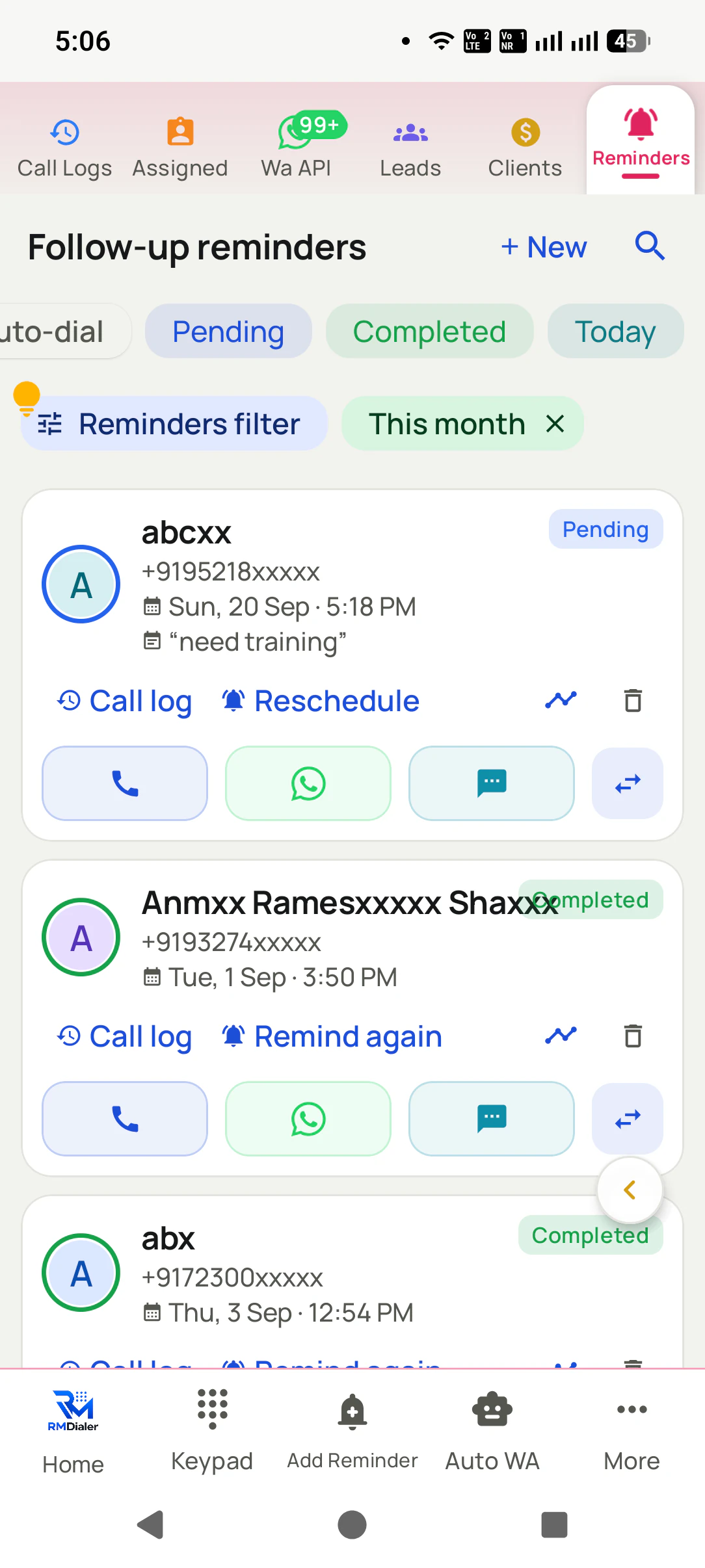
Try it with your own workflow
Bring a list of existing customers and we will show a session on a UK SIM, the callback that rings on its date and the status that keeps an objector off every future list.
Team features, one plan
₹159/user/month
₹1,908 per user, billed yearly, plus taxes.
The personal dialer, call log and personal analytics are free forever. Team access and saved lead workflows require a plan. SIM charges and any WhatsApp provider charges are separate.
Compare free and paid features →Yes. UK law regulates the call, not the software. An unsolicited live marketing call must go to a number screened against the TPS register (and the CTPS for company numbers), show your number and stop when the person objects. A marketing call that plays a recorded message needs explicit consent first. A dialler ringing one number at a time with a person speaking places ordinary calls. Not legal advice.
Compare the rules in seven countriesRMDialer is an auto dialer UK teams run on their own mobiles: it rings a filtered list one number at a time through the UK SIM in an Android phone, so the person sees your 07 number, and it asks for the outcome and any callback after each call. It costs $29 per seat a year, converted to pounds by your card, with no minutes billed by us.
Yes. RMDialer works as an auto dialler for UK businesses on any UK network and tariff, in an Android phone from version 8. It has no predictive mode and places no recorded calls, so every answered call reaches the person who pressed start.
Screening a list against the Telephone Preference Service register and removing the matches before any unsolicited live marketing call. You need it for numbers you have no relationship with, such as a bought file or a portal export, not to ring your own customers about their own agreement. A new registration takes effect after 28 days, so screen close to the calling date.
No. TPS and CTPS screening happens before upload, through the licensed service or a screening bureau, and it is a separate fee. What RMDialer does is keep the objection afterwards: a "do not call" status stays on the person and keeps them out of every later list.
RMDialer is $29 per seat for a year or $12 for three months, billed in dollars and converted by your card. Calls use the UK SIM's own minutes, so there is no per-minute charge, no rented 03 number and no bigger tier for the fourth seat. TPS screening, if you need it, is bought separately.
See every plan and priceNo. A power dialler rings the next number only when the caller is free, so every answered call meets a person. A predictive dialler rings several numbers per agent on the odds most will not answer and drops the extra, which is where silent calls come from. RMDialer is the power kind, and it has no predictive setting.
Ofcom acts on calls where someone answers and hears nothing, or is cut off, because a system rang more numbers than it had agents free. Repeated silent calls count as persistent misuse, with fines of up to two million pounds. A phone can only hold the call it is on, so a one-at-a-time dialler does not create them.
For most of it, yes. The RMDialer iPhone app has every feature except the call log: leads, remarks, callbacks and WhatsApp all work. Ringing a list back to back needs the phone's dialler role, which iOS gives to no app, so the negotiators doing the calling sessions use Android handsets with the office SIM.
For a marketing call that plays a recorded message, yes: explicit consent from each person, beforehand. It is the strictest line in PECR. RMDialer places no recorded calls, so the only basis in play is the ordinary one for a live call from a person.
Official sources. The screening duty, the 28 days, the displayed number, consent for recorded messages and Ofcom's role on silent calls were checked against these pages. Plain information, not legal advice.