
The callback list
Every missed call waits in its own list until someone rings back, so the WhatsApp never stands in for the call itself.
Missed call auto WhatsApp
You were on another call, driving, or with a customer, and the phone rang out. RMDialer sends your WhatsApp to that caller the moment the ringing stops, so they hear from you in seconds instead of ringing the next business on their list.
Free personal dialer. Paid features include a 3-day trial; no card required.
Team plans: ₹159/user/month, billed yearly + taxes →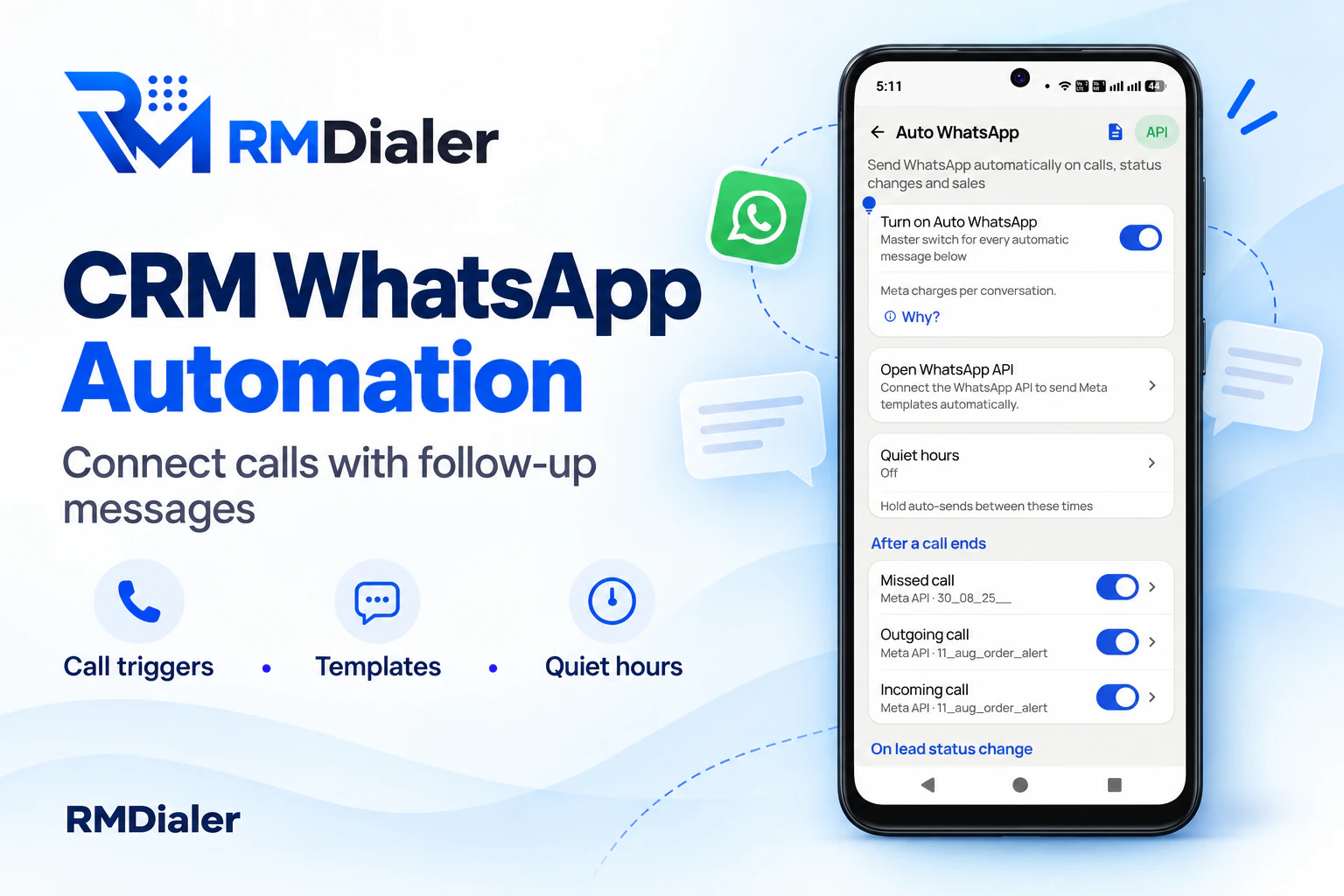
No campaign number to rent: it works on the SIM your customers already ring.
Short answer
Switch on the Missed call rule in RMDialer’s Auto WhatsApp and choose its message once. Every call you miss on your own phone then gets that WhatsApp the moment the ringing stops, through the WhatsApp Business API, with a cooldown so a caller who rings again is not messaged twice.
Key takeaways
Two different things
Results for this search mix two services that only share a name. Check which one you are after before choosing a tool.
| Kind | Who gives the missed call | How the WhatsApp is sent | Suits |
|---|---|---|---|
| A missed call on your own number | Customers who rang you and you could not pick up | The phone app sees the missed call and sends your WhatsApp | Shops, clinics, agents, sales teams |
| A rented missed-call number | People told to give a missed call to a campaign number | The provider’s server cuts the call and replies | Advertising campaigns, opt-ins, contests |
RMDialer is the first row. If you are running an advertisement that asks people to give a missed call to a published number, that is a telephony campaign service, not a phone app.
A pathology lab in Indore
Picture a pathology lab in Indore that books home sample collection by phone. Between seven and ten in the morning the front-desk phone rings far more than one person can answer, and every unanswered caller is someone fasting for a blood test who will try another lab.
With the missed-call rule on, each of those callers gets a WhatsApp within seconds: sorry we missed you, the collection slots still open today, and a line inviting them to reply with the test name. Many book in the chat before the desk can ring back. A patient who rings four times in ten minutes gets one message, not four.
The missed calls stay in their own list for the callback. Labs that want a second note can use the winback series instead of the single rule: missed callers join it by themselves, and its next message goes the following morning unless they have replied or been reached by phone. The details are an illustration, not a named client.
After the first message
One message catches most people. For the rest, three tools work together.
Every missed call waits in its own list until someone rings back, so the WhatsApp never stands in for the call itself.
A ready-made follow-up series joins missed callers by itself and sends its next notes on later days, at the time you choose. A reply or a connected call ends it at once.
A log of each missed-call message and what became of it, so you can see which callers were reached and which the cooldown held back.
The rules for outgoing and incoming calls work the same way; see auto WhatsApp message after every call. Wording ideas for a missed-call reply are in WhatsApp auto reply message samples, and the callback routine in the missed call follow-up system. For callers who are not on WhatsApp, see auto SMS after a call; for everything that runs after a call, post call automation.
Try it with your own workflow
We switch on the missed-call rule with your template, ring your phone from another number and let it go unanswered, so you see the WhatsApp arrive.
Team features, one plan
₹159/user/month
₹1,908 per user, billed yearly, plus taxes.
The personal dialer, call log and personal analytics are free forever. Team access and saved lead workflows require a plan. SIM charges and any WhatsApp provider charges are separate.
Compare free and paid features →In RMDialer, open Auto WhatsApp, switch on the Missed call rule and choose its message. From then on, every call you miss on your phone gets that WhatsApp the moment the call stops ringing, through the WhatsApp Business API.
No. It works on the number customers already call, the SIM in your phone. A separate missed-call number is a different service, used for campaigns where people are asked to ring a published number.
To send with no tap, yes, with an approved template, because the customer has not messaged you first. Without the API, RMDialer shows a notification with the message ready, and one tap opens WhatsApp to send it.
No. Each number has a cooldown, so a customer who rings again a few minutes later does not get the same WhatsApp twice. Quiet hours hold messages for missed calls at night until the morning.
Yes, when the number is already a lead or contact: {name} fills in from the record. For a number the app has never seen, write the message so it reads well without a name.
Say sorry you missed them, when you will call back, and invite them to type what they need. Example: “Hi, we missed your call at [Business]. We will ring you back within 15 minutes, or reply here with your question and we will answer it first.”
Yes, with a follow-up series. The ready-made Missed-call winback series starts by itself on a missed call and sends its next messages on later days at a time you set. It stops the moment the person replies or a call with them connects.
Yes. Excluded contacts never receive automatic messages, which suits family, staff and suppliers who ring the same phone. You can also turn on ask-before-send so each message waits for your yes.
No. Its away and greeting messages answer WhatsApp chats, not phone calls. Only an app that is your phone app, or a provider handling your calls, can see a call was missed and reply to it.
Open the Auto WhatsApp history. Each missed-call message shows whether it went out, or why it was held back: a cooldown, quiet hours or a template problem. Nothing is sent behind your back.
The missed-call rule costs nothing on its own; it comes with the RMDialer subscription, ₹159 for each user monthly in India on an annual plan, GST extra; $29 per user per year, or $12 per user for 3 months, outside India. Meta charges for API messages separately, through whichever provider you use.