
The buyer says hello
Someone who asked about a two-bedroom condo last week picks up. The dialer is still deciding whether it reached a person or a voicemail greeting.
Power dialer for real estate
With a power dialer for real estate, your list rings itself, one line at a time, so every buyer who answers hears you, not a pause. The next number waits until the showing or callback is saved.
Free personal dialer. Paid features include a 3-day trial; no card required.
Team plans: ₹159/user/month, billed yearly + taxes →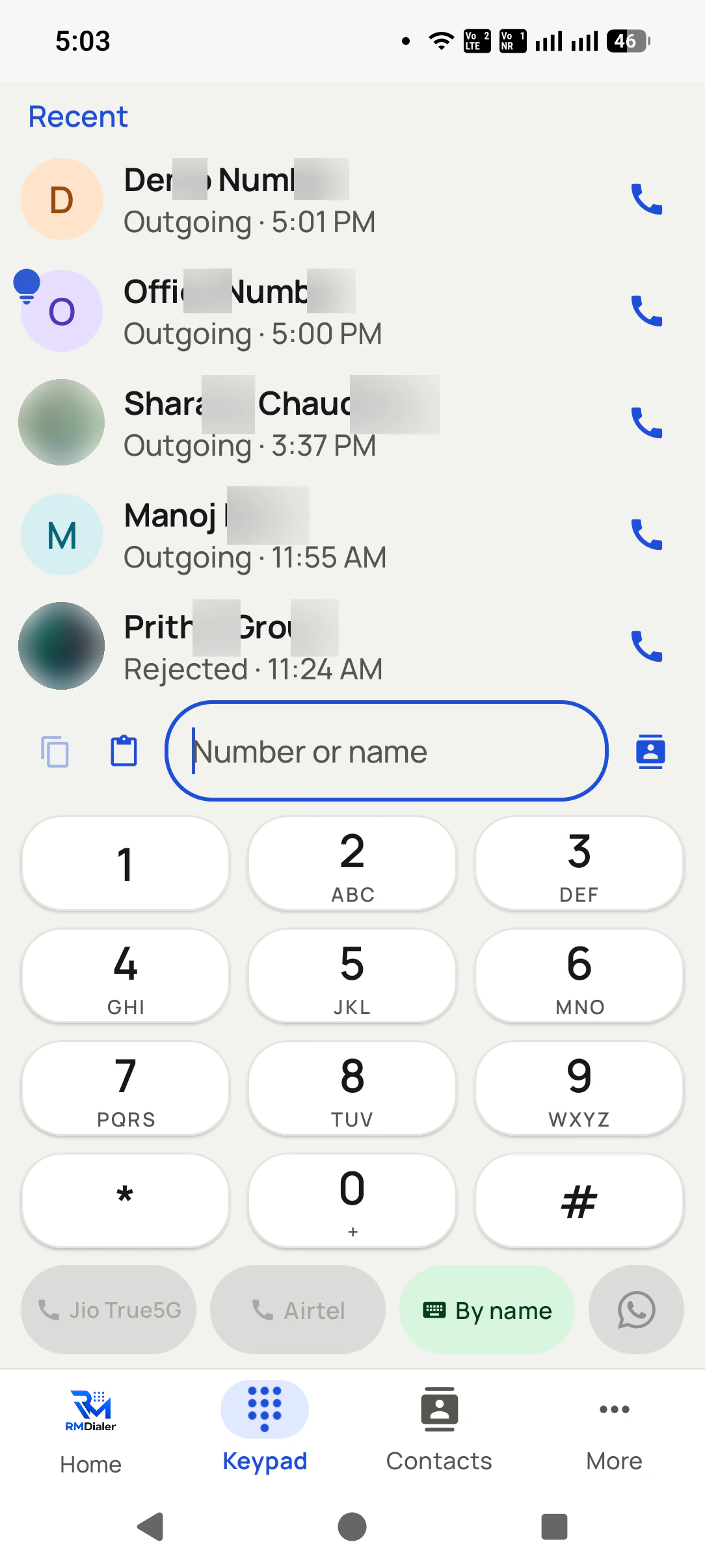
Short answer
The best power dialer for real estate agents calling warm leads is one that rings one buyer at a time, so whoever answers hears the agent at once. RMDialer is a power dialer for real estate that does exactly that from the SIM in the agent's Android phone: buyers see the number on the agent's signs and listings, not a virtual number. The agent filters the list (new enquiries, open house sign-ins, anyone not called in seven days), presses start, and the next number rings only after the last call's showing, remark or callback is saved. It has no predictive or parallel mode, so it cannot create the abandoned calls that regulators cap. It suits solo agents and small teams on warm lists, not cold call floors. RMDialer costs about ₹159 per user per month on the yearly plan in India, or $29 per user per year, or $12 per user for 3 months, outside India.
Key takeaways
Sort them by lines per agent
Sales pages mix the names up. Sort them by one thing: how many lines ring for each agent, and what the buyer hears when they answer.
| Mode | How it rings | What the buyer hears | Lines per agent |
|---|---|---|---|
| Preview dialer | The lead shows first; nothing rings until the agent taps call. | The agent, straight away. | One, started by hand |
| Power (progressive) | The next number rings once the last call is finished and noted. | The agent, straight away. | One, started by the software |
| Predictive | Rings more numbers than there are free agents, set by a pacing ratio. | Often a pause; if nobody is free, a dead line. | Several, shared across a team |
| Parallel (multi-line) | One agent rings several numbers at once and talks to whoever answers first. | If two answer together, one gets silence or a drop. | Several, for one agent |
The connect delay
One answered call on a three-line dialer, second by second. Rounded, illustrative timings.
Someone who asked about a two-bedroom condo last week picks up. The dialer is still deciding whether it reached a person or a voicemail greeting.
A second number in the same batch has picked up, and the agent is already talking there. The first buyer says "hello?" again, louder.
Either a message plays or the line goes dead. The buyer now thinks it was spam, and the agent's next real call to them goes unanswered.
On a one-line dialer that sequence cannot happen. The agent is holding the phone when the number rings, so the first sound after hello is a voice, and a voicemail is just a voicemail the agent hears and decides about. In the UK, Ofcom calls the bad version a silent call.
A worked example
Picture a resale condo agent in Toronto with about 600 names: open house sign-ins, people who asked about the maintenance fee on a listing, past buyers. A new one-bedroom comes up near the waterfront. A parallel dialer ringing three lines produces around 900 dials in a week, but because these contacts are warm, two lines often answer together, and roughly 60 people get a connect delay and a drop. Several past clients stop picking up that number.
The next week the agent rings one line at a time from their own mobile. Dials fall to about 400, conversations rise because nobody is lost after hello, and booked showings roughly double, each saved before the next ring. The CRTC counts a call as abandoned when no live person speaks within two seconds, so the parallel week was exactly what those rules were written for. An illustration built from a common pattern, not a customer result.
See how an office calling team runs →The rules
None of these rules bans dialing software. They measure what happens after a person answers, which is the moment a multi-line dialer gets wrong. General summary, not legal advice.
| Where | Abandoned call limit | How it is counted |
|---|---|---|
| United States (FCC) | No more than 3% of answered telemarketing calls per campaign, over 30 days. | Abandoned if not put through to a live person within 2 seconds of the greeting ending. |
| United Kingdom (Ofcom) | At or under 3% of live calls per campaign over 24 hours. | A short message must play when nobody is free; no repeat within 72 hours without an agent guaranteed. |
| Canada (CRTC) | No more than 5% in a calendar month for predictive dialing. | Abandoned if no live telemarketer speaks within 2 seconds of the answer. |
A 3% cap sounds generous until you run parallel lines on warm property leads, who answer far more often than cold data. Consent, calling hours and do-not-call lists are separate rules. Sources: FCC 47 CFR 64.1200, Ofcom's statement of policy on persistent misuse, CRTC Unsolicited Telecommunications Rules.
Match the mode to the agent
The deciding question is how many of the people you ring actually answer. The warmer the list, the fewer lines you want.
Power or preview. Every answered call is someone who wants a showing. RMDialer fits.
Power. These people know the agent's name and should hear that voice first. RMDialer fits.
Predictive or parallel with do-not-call checks and consent records. RMDialer is not the right tool.
A three-day trial
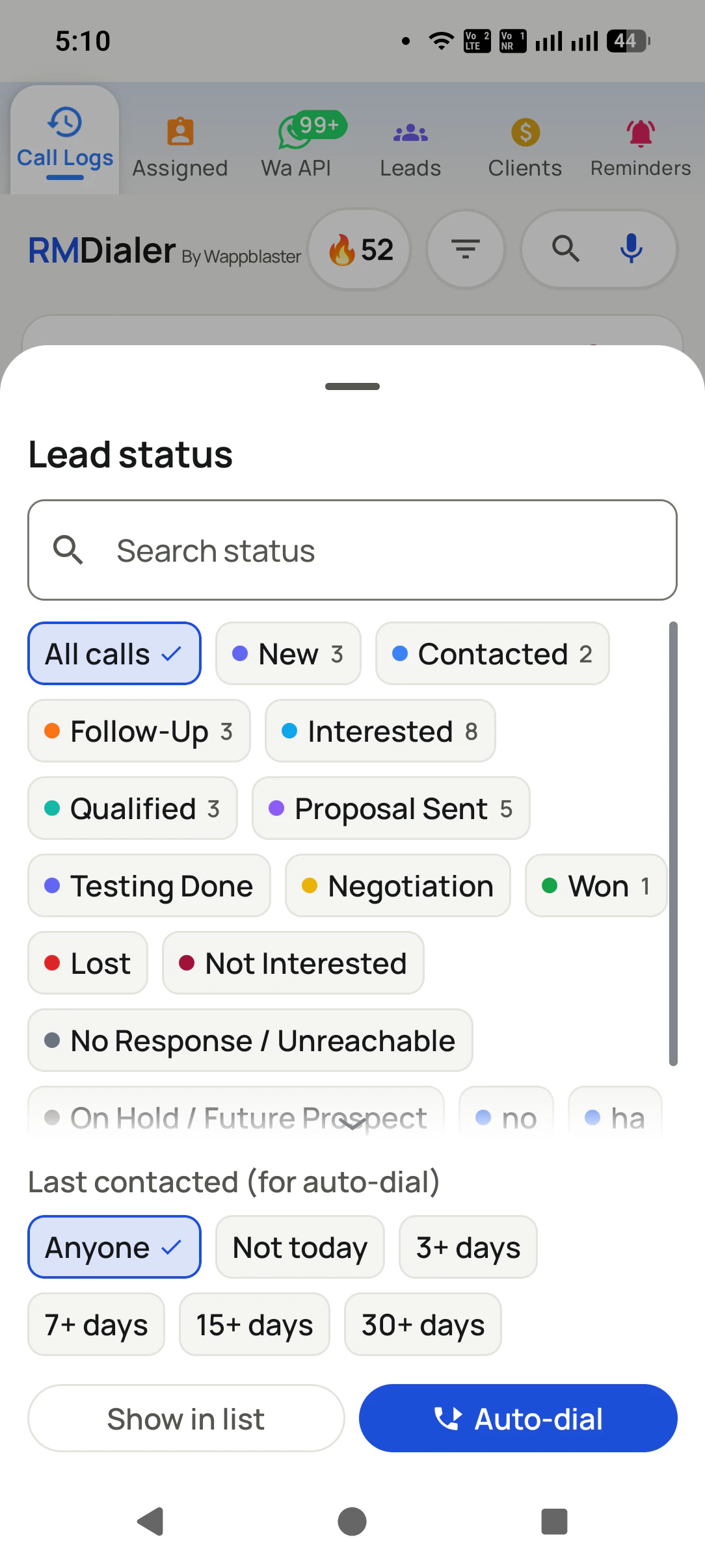
Day one: set the work SIM, filter this week's enquiries and ring twenty in one session; note how many answered and whether anyone heard a pause (nobody should). Day two: book every showing as a reminder with the confirmation message attached and check they ring on time. Day three: ring the no-answers at a different hour and compare.
If a dialer shows big dial counts but fewer conversations than calling by hand, it is costing you buyers, whichever product it is.
The four dialer types, for any sales team →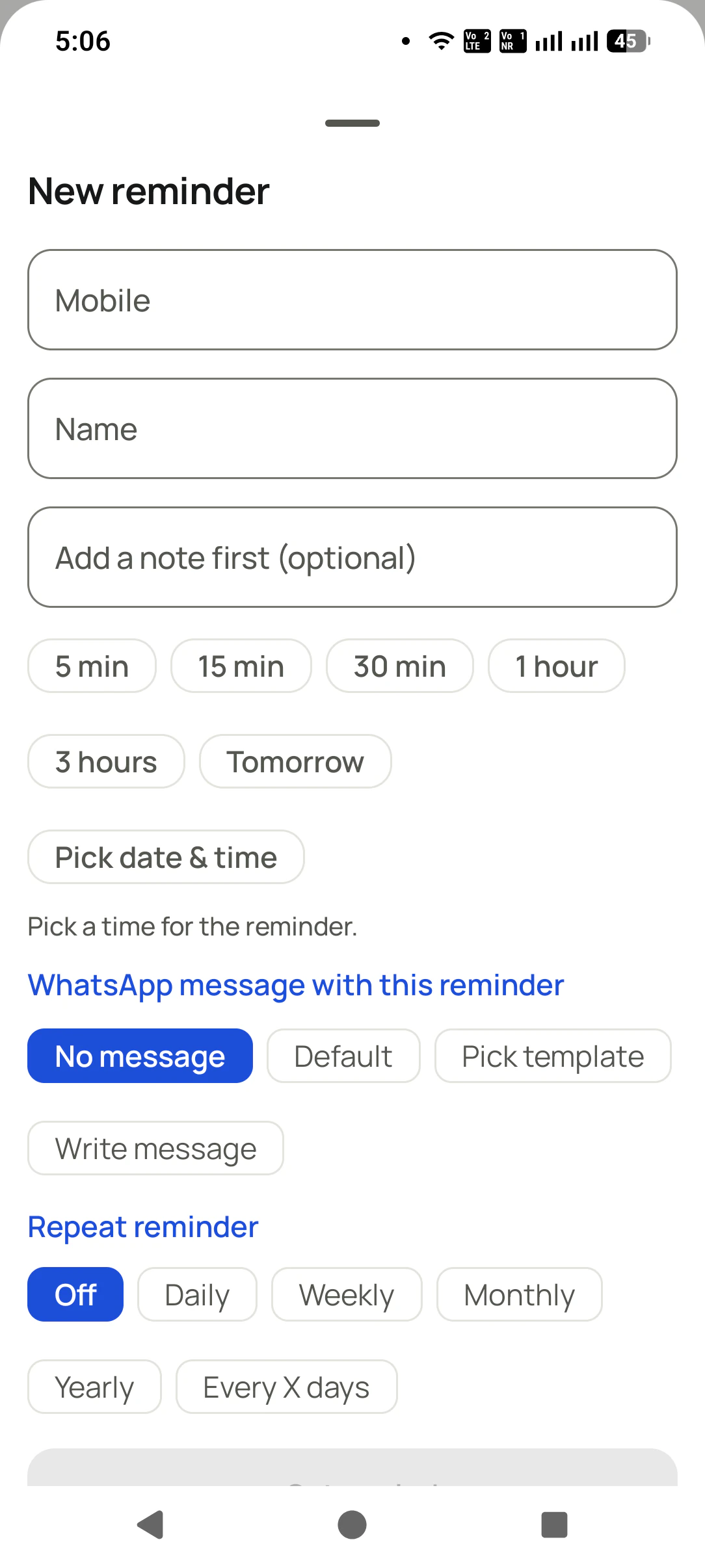
Try it with your own workflow
Bring twenty warm leads. We will show a session from your own mobile, the showing booked as a reminder and the note saved before the next ring.
Team features, one plan
₹159/user/month
₹1,908 per user, billed yearly, plus taxes.
The personal dialer, call log and personal analytics are free forever. Team access and saved lead workflows require a plan. SIM charges and any WhatsApp provider charges are separate.
Compare free and paid features →A power dialer rings the next number on a list automatically as soon as the agent finishes the last call, one line at a time. The agent never types or searches, and because only one number rings for one agent, the person who answers hears the agent straight away. Power and progressive dialer are two names for the same thing.
RMDialer is a power dialer for real estate agents that rings from your own mobile: it places ordinary calls through the SIM in an Android phone, one buyer at a time, so they see the number on your signs and listings. It waits for your note or callback before the next call and costs about ₹159 per user per month on the yearly plan in India, or $29 per user per year, or $12 per user for 3 months, outside India.
Yes. RMDialer works as a power dialer for real estate teams: each agent rings their own filtered list from their own phone, and the owner sees every call, status and booked showing in the Web CRM. It has no predictive or parallel mode.
It depends on how many of the people you ring actually answer. For warm lists (enquiries, open house sign-ins, past clients) a one-line power or preview dialer is best, because nobody is lost to a pause after hello. For a large cold list where most never answer, multi-line dialers keep agents busier, along with the compliance duties that come with them.
No. A power dialer rings one number for one agent who is ready to talk, which is allowed in the US, the UK, Canada and India in general. The rules apply to the list and the calling: consent, do-not-call registers and calling hours. Regulators also cap abandoned calls, which one-line dialing does not create. This is not legal advice.
Cold calling rules by countryRarely in full. RMDialer's basic phone dialer is free, and automatic list dialing, the lead record and reminders are on the plan, which can be tried free for 3 days without a card. Calls run on your own mobile plan, so there is no per-minute bill on top.
What a free dialer really costs an agentA power dialer rings the next lead only when the agent is free, so the buyer hears a person at once. A predictive dialer rings extra numbers on a guess about how many will answer, which saves agent time on big cold lists but causes pauses and dropped calls when the guess is wrong. On warm property leads, those pauses cost more than they save.
Roughly 30 to 60 dials an hour on a one-line dialer, depending on how many answer, how long each conversation runs and how long the note takes. Multi-line dialers report bigger dial counts, but dials are not conversations. In RMDialer each agent sets the gap between calls in seconds.
Not for the dialing sessions. Ringing a list back to back needs the phone's dialer role, which iOS gives to no app. The RMDialer iPhone app has every other feature except the call log, so an iPhone agent keeps leads, remarks and callbacks there and uses an Android handset with the work SIM for sessions.
Not automatically. There is no automatic retry. Filter the no-answers and start a fresh session later, ideally at a different hour, since a buyer at work at noon may pick up after six.